


Posting a vacancy reaches people who are looking. Sourcing in the recruitment process is the proactive work of identifying, researching, approaching, and engaging potential candidates before screening and selection. It expands the available talent pool to include passive professionals, referrals, specialist communities, past applicants, and people with transferable skills.
Good sourcing begins with a precise success profile and ends with a qualified, engaged pipeline. It does not end with a long list of names.
Key Takeaways
- Sourcing identifies and engages potential candidates, while recruiting also covers screening, interviews, offers, and hiring.
- Begin with role outcomes, essential skills, location, compensation, work model, and joining timeline before choosing channels.
- Segment active applicants, passive prospects, referrals, alumni, past candidates, and adjacent-skill talent instead of sending one message to everyone.
- Measure qualified response and pipeline conversion by source, not only profile volume.
- Apply consistent, job-related criteria across sources so channel expansion does not weaken selection quality or fairness.
Where Does Sourcing Fit in the Recruitment Process?
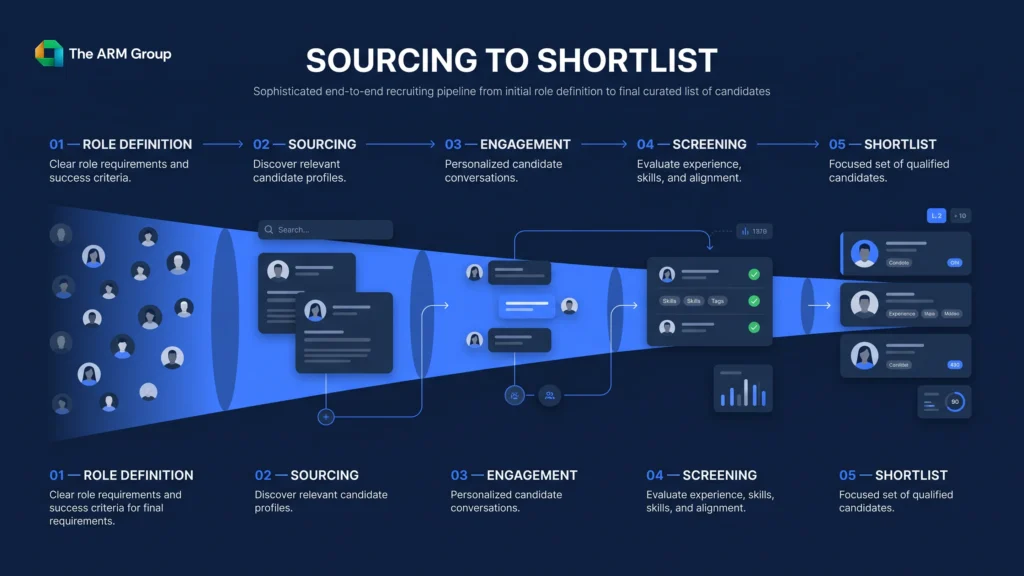
Sourcing sits between role definition and formal assessment. It turns a hiring requirement into a reachable market of potential candidates. Recruitment continues through screening, interviewing, selection, offer, joining, and onboarding.
The distinction matters because a sourcing team should not be rewarded for producing profiles that recruiters cannot progress. A useful handoff includes contact status, interest, location, compensation alignment, availability, evidence of relevant capability, and any material constraint.
The ARM Group’s professional recruitment service combines targeted sourcing with screening, shortlist development, interview coordination, and joining support. For leadership roles, ARM Elite adds market mapping, confidential outreach, and leadership evaluation.
How Do You Build a Sourcing Brief?
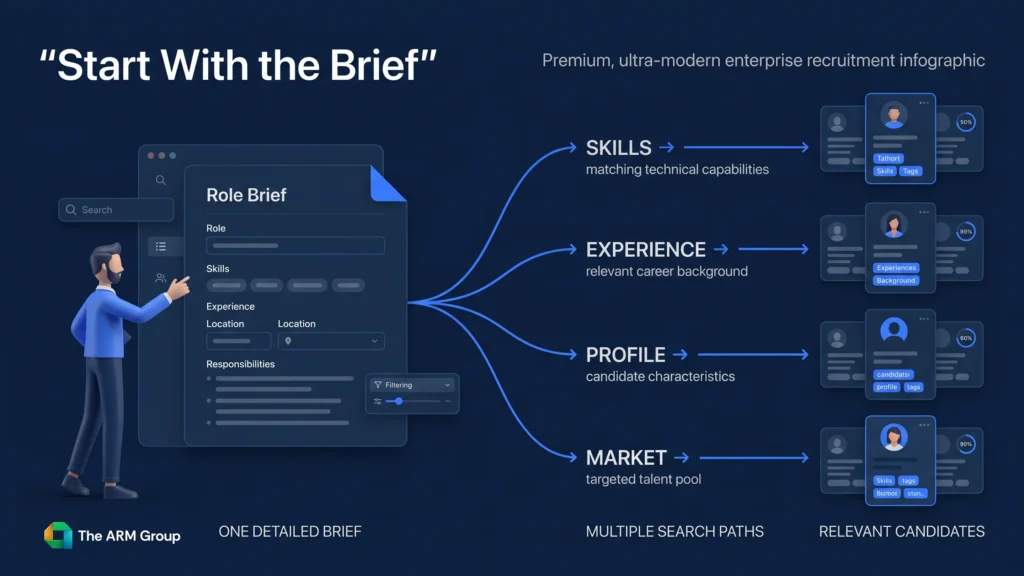
A sourcing brief defines evidence of success before anyone searches a database. Replace a copied job description with a concise market-facing specification.
Include:
- The business reason for the hire.
- The outcomes expected in the first 6 to 12 months.
- Essential and preferred skills, with evidence for each.
- Industry or environment requirements that genuinely matter.
- Location, travel, shift, and work-model constraints.
- Compensation guidance and approval range.
- Interview stages, decision-makers, and joining date.
- Acceptable adjacent backgrounds and trainable gaps.
For U.S. roles, the O*NET Content Model provides structured information about tasks, skills, knowledge, abilities, work activities, and work context. Use it as a starting point, then adapt the brief to the actual job.
Which Sourcing Methods Work Best?
Use a channel mix based on where the required talent can realistically be reached. Broad job boards may work for active candidates in common roles. Specialist roles often require direct outreach, referrals, professional communities, alumni, associations, and market mapping.
| Method | Best Fit | Main Risk |
| Job boards and careers pages | Active candidates and visible roles | High volume with uneven relevance |
| Direct search and outreach | Passive specialists and hard-to-fill roles | Generic messages produce low trust |
| Employee and professional referrals | Trusted networks and niche communities | Repeated networks can narrow representation |
| Past applicants and alumni | Previously engaged, known talent | Old data and changed candidate expectations |
| Events, associations, and communities | Skill or industry-specific talent | Relationship building takes time |
| Recruitment partner | Urgent, multi-location, niche, or confidential hiring | Poor briefs still create poor pipelines |
The BLS Occupational Outlook Handbook and occupation-level projections can help test whether a talent shortage reflects long-term demand, replacement needs, or a narrowly defined requirement.
How Do You Source Passive Candidates?
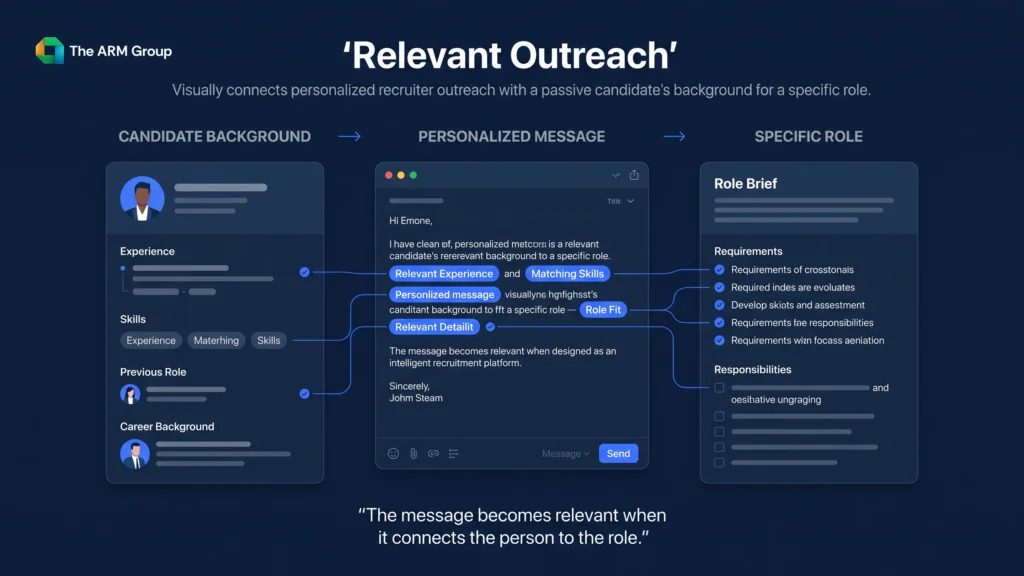
Passive sourcing works when outreach explains why the role is relevant to that person. A credible message connects their background with a specific business problem, scope, team, location, and career reason to talk.
Do not open with a vague request for a resume. Explain what is known, what remains confidential, and what the first conversation will cover. If compensation, work model, travel, or location is fixed, share it early enough to prevent wasted discussions.
For confidential leadership searches, sequence outreach carefully and limit unnecessary disclosure. For cross-border roles, account for time zones, local market expectations, notice periods, and the employer’s hiring structure. The ARM Group’s cross-border hiring support focuses on U.S.-India talent requirements.
How Should You Screen a Sourced Pipeline?
Screen every candidate against the same role-related evidence, regardless of source. Referrals and direct-sourced candidates should not bypass standards applied to applicants.
The EEOC’s small-business hiring guidance advises employers to apply the same standards consistently and avoid decisions based on protected characteristics. The agency’s selection-procedure guidance also explains that tests and other selection tools must comply with federal anti-discrimination law.
Use a structured screen that checks relevant experience, work examples, motivation, location, availability, compensation alignment, communication, and essential constraints. Record evidence and the reason for progression or rejection.
Which Recruitment Sourcing Metrics Matter?
The strongest metrics connect a source to qualified progress, not activity alone. Track outreach volume only as an input. Pair it with reply rate, interested response rate, qualified rate, screen-to-interview conversion, interview-to-offer conversion, offer acceptance, joining rate, time in stage, and source quality after hire.
Review metrics by role family, location, seniority, and channel. A source that performs well for engineers may perform poorly for plant supervisors. A channel with fewer profiles can be more productive if its qualified conversion is higher.
Also measure data freshness and pipeline aging. A large database loses value when availability, compensation, skills, or consent information is outdated.
What Sourcing Failure Modes Should Employers Avoid?
The most common failure is scaling outreach before fixing the brief. More messages amplify unclear requirements. Other failures include searching only exact job titles, excluding adjacent industries without evidence, hiding compensation constraints, copying one outreach message, and measuring recruiters by profile count.
Slow feedback also damages sourcing. Interested candidates disengage when hiring managers take days to review profiles or repeatedly change the requirement. Align service levels for profile review, interview scheduling, feedback, and offer decisions before outreach begins.
Talk to The ARM Group about the sourcing approach, screening depth, and recruitment model that fit your roles and hiring market.
FAQs
What Is Sourcing in Recruitment?
Sourcing is the proactive process of identifying, researching, approaching, and engaging potential candidates for current or future roles. It creates the pipeline that later recruitment stages assess.
What Is the Difference Between Sourcing and Recruiting?
Sourcing focuses on finding and engaging potential candidates, while recruiting covers the wider path from requirement definition through hiring and onboarding. In some teams, one person performs both functions.
What Is Direct Sourcing?
Direct sourcing means building and engaging a talent pool directly rather than depending only on incoming applications or third-party submissions. It may include alumni, former applicants, referrals, contractors, and passive prospects.
Which Channels Are Best for Recruitment Sourcing?
The best channels depend on the role, location, seniority, scarcity, and candidate behavior. Use channel conversion data instead of assuming one platform works for every position.
How Do You Source Passive Candidates?
Research relevant backgrounds, write personalized outreach, state the credible reason to talk, and make the first step easy. Share material constraints early and follow up respectfully.
What Should Be Included in a Sourcing Brief?
A sourcing brief should include outcomes, essential skills, acceptable adjacent backgrounds, location, work model, compensation, timing, interview process, and evidence required for progression. It should be shorter and more precise than a generic job description.
How Is Sourcing Effectiveness Measured?
Measure qualified response, pipeline conversion, time in stage, offer acceptance, joining rate, and post-hire source quality. Profile volume alone rewards activity rather than results.
When Should an Employer Use a Recruitment Partner?
A recruitment partner becomes useful for niche skills, passive talent, confidential searches, multi-location hiring, urgent demand, or limited internal sourcing capacity. The brief and decision process still need employer ownership.
Conclusion
Define success, map the market, choose channels, personalize engagement, and screen every source consistently. Then compare sources based on qualified conversions and hiring outcomes. An external recruitment partner adds value when the internal team’s reach is exceeded in terms of access, specialization, confidentiality, or hiring volume.

Kiran Kumar Naik
Kirankumar Naik is a Client Partner (Business Development Manager) at The ARM Group, where he helps product- and service-based companies scale their teams by connecting them with the right talent. His expertise spans lead generation, marketing, and sales, and he thrives on building long-term partnerships that drive business growth. Focused on deeply understanding client needs, Kirankumar delivers solutions that make a real impact — turning complex hiring challenges into win-win outcomes for clients and candidates alike, across leadership, lateral, and contract hiring worldwide.