
CEO hiring differs from other recruitment processes. Recent trends show a 40% rise in highly specialized CEO mandates, emphasizing that leadership requirements vary by business stage and industry.
There is no universal checklist because no single leadership profile matches every organization. Business operations vary so greatly between companies that the successful techniques of one organization will fail in another operating within the same industry.
The CEO executive search requires more time because it involves multiple uncertainties, which make it more difficult to choose candidates than in typical leadership hiring processes. The hiring process needs to evaluate candidates based on their potential to lead and drive business development.
You need to assess candidates’ ability to lead your organization and to develop their future business strategy.
The CEO sets direction, shapes culture, earns investor trust, boosts productivity, and ensures sustained organizational growth. The cost of a hiring mistake exceeds most other hiring costs.
This is where CEO recruitment agencies come in. Specialized leadership search partners such as The Arm Group help bring structure and clarity to CEO hiring.
The guide outlines all processes agencies follow during CEO searches and explains how to select an appropriate executive hiring agency.
What Do CEO Recruitment Agencies Do?
CEO recruitment agencies identify, evaluate, and secure top leadership talent. Their operations differ from those of hiring companies, as they offer more than just candidate placement.
At the CEO level, alignment includes:
- Business Stage
- Growth Goals
- Board Expectations
- Leadership Style
- Industry Background
- Transformation Capability
- Investor-facing Confidence
This is what makes CEO executive search fundamentally different from general recruitment.
Rather than passively waiting for applications, CEO recruitment agencies take a proactive approach in the market.
They usually:
- Map leadership talent across relevant companies
- Identify CEOs, MDs, COOs, or business heads with transferable experience.
- Approach candidates discreetly
- Assess long-term fit
- Evaluate leadership maturity and strategic capability.
A leadership mismatch at this level affects the entire enterprise, potentially disrupting overall performance, stakeholder confidence, and the organization’s trajectory.
A poorly aligned CEO can disrupt:
- Culture
- Strategic Priorities
- Team Retention
- Market Positioning
- Investor Relationships
This is why structured executive search becomes critical. Solutions like ARM Elite are specifically designed for CEO, C-suite, and senior leadership search.
Why CEO Hiring Is More Complex?
CEO hiring goes beyond credentials. Your organization requires a leader who can strategically guide its growth and long-term success.
A CEO who excels at managing a large organization that relies on standardized processes will struggle to lead a fast-paced startup environment. A founder-style growth leader lacks the necessary proficiency to serve as an executive in an organization that requires extensive governance.
The CEO hiring process requires advanced assessment methods that must be applied throughout the candidate evaluation period.
- Fewer Available Candidates
The executive talent pool is smaller. Far fewer professionals have proven CEO-level experience compared to other leadership roles. In many industries, the realistic shortlist is extremely limited.
- Higher Stakeholder Expectations
CEO hiring often involves multiple stakeholders, including:
- Founders
- Board Members
- Investors
- Senior Leadership Teams
- HR Leadership
This introduces heightened complexity to alignment and approval, necessitating disciplined leadership consensus.
- Leadership Style Matters More Than Ever
At this level, leadership style becomes as important as experience.
Questions often include:
- Can they lead through uncertainty?
- Can they inspire teams?
- Can they manage board expectations?
- Can they make difficult strategic decisions?
- Long-Term Business Impact
A CEO hire affects the business for years, not months. This is why there is very little room for error.
Even small misalignment at this level can have significant consequences.
How CEO Search Differs by Industry?
A common misconception is that CEO hiring functions uniformly across industries. In reality, the process varies by sector due to unique industry demands, business dynamics, and organizational development stages.
This is one of the main reasons specialized CEO recruitment agencies often deliver better results.
- Manufacturing & Automotive
Operational leadership builds the core foundation for CEO hiring in the manufacturing and automotive industries.
Priority areas include:
- Operational Efficiency
- Scale Management
- Supply Chain Visibility
- Plant and Production Leadership
- Cost Optimization
A CEO in manufacturing or automotive often requires deep expertise in executing large-scale operations, as these industries prioritize operational excellence and plant management more than others.
- Technology & IT
In technology businesses, the expectations shift.
The emphasis is often on:
- Product Vision
- Innovation Mindset
- Market Adaptability
- Digital Transformation
- Growth Strategy
For SaaS and IT companies, CEO leadership must blend a strong understanding of product-market fit with the ability to scale digital businesses, which sets these leaders apart from those in other sectors.
- Financial Services
A CEO search in finance and banking requires a stronger governance lens.
This often includes:
- Regulatory Understanding
- Risk Management
- Compliance Leadership
- Stakeholder Trust
- Strategic Capital Decisions
Industry credibility is especially critical in financial services, where trust, regulatory insight, and demonstrated experience in financial oversight distinguish successful CEOs, even more so than in other sectors.
- Startups & Emerging Businesses
Startup CEO hiring is often the most different.
The focus usually shifts toward:
- Growth Mindset
- Fundraising Capability
- Investor Communication
- Building Teams from Scratch
- High-speed Decisions
A startup CEO must combine operator thinking with visionary leadership. Since expectations can vary widely, industry context is crucial.
A generalist approach to recruitment often fails to account for these crucial industry distinctions, resulting in a misalignment between CEO capabilities and organizational needs.
What to Expect From a CEO Hiring Process?
CEO hiring is usually longer and more structured than standard recruitment.
Here is what the process looks like.
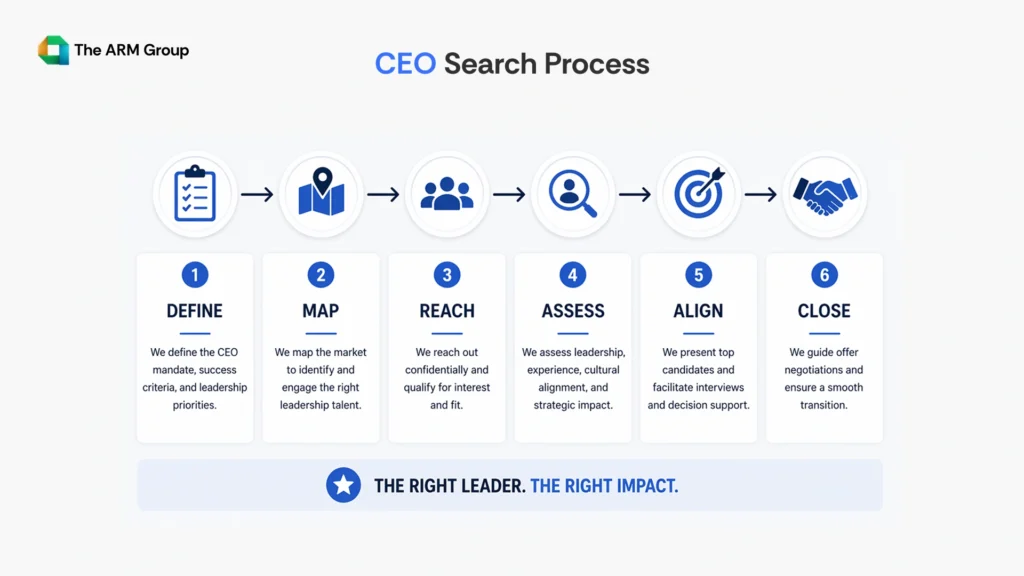
- Defining Leadership Expectations
This is far more detailed than a normal job description.
It includes defining:
- Business Objectives
- Leadership Mandate
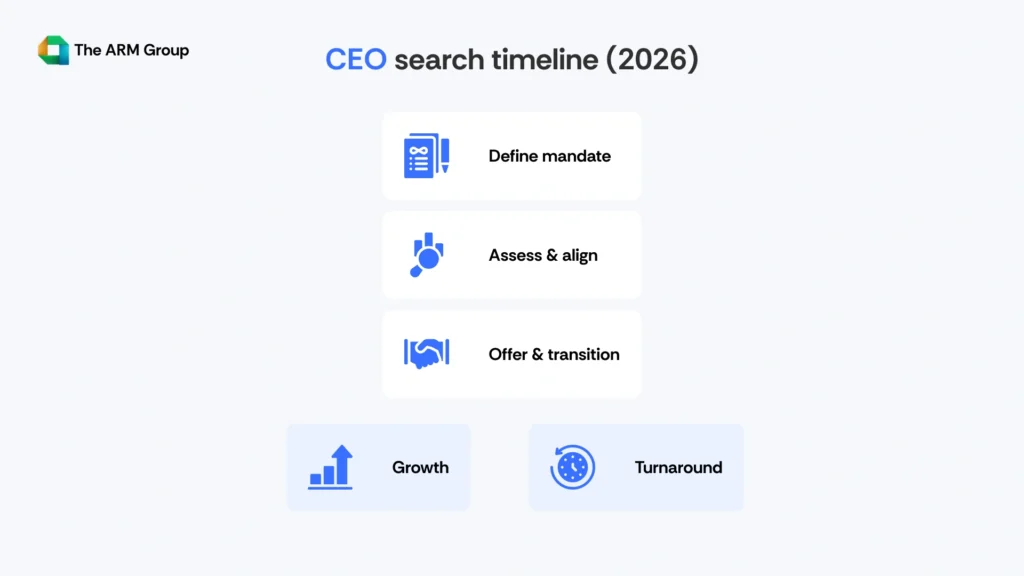
- Turnaround vs Growth Expectations
- Stakeholder Priorities
- 12–24 Month Outcomes
The real question here is:
What does success in this CEO role actually look like?
- Market Mapping
The recruitment partner identifies where suitable candidates are likely to be working.
This may include:
- Competitors
- Adjacent Industries
- Business Heads Ready for CEO Transition
- Current CEOs in Comparable Organizations
For senior functional and business-unit leadership hiring, ARM Professional can support succession-ready talent searches.
- Candidate Outreach
At this level, outreach is almost always direct and discreet. Candidates are approached confidentially.
- Multi-stage Evaluation
CEO hiring usually includes multiple rounds focused on:
- Strategic Thinking
- Leadership Style
- Business Problem-solving
- Stakeholder Communication
- Culture Fit
This stage is usually more extensive than standard leadership hiring.
- Stakeholder Alignment
One of the most important parts of CEO hiring is keeping all leaders aligned. Without this, delays increase significantly.
- Offer & Transition Support
Final-stage support often includes:
- Compensation Negotiation
- Transition Planning
- Notice Period Management
- Onboarding Strategy
Common Challenges in CEO Hiring
Even experienced businesses face challenges during a CEO search.
Some of the most common include:
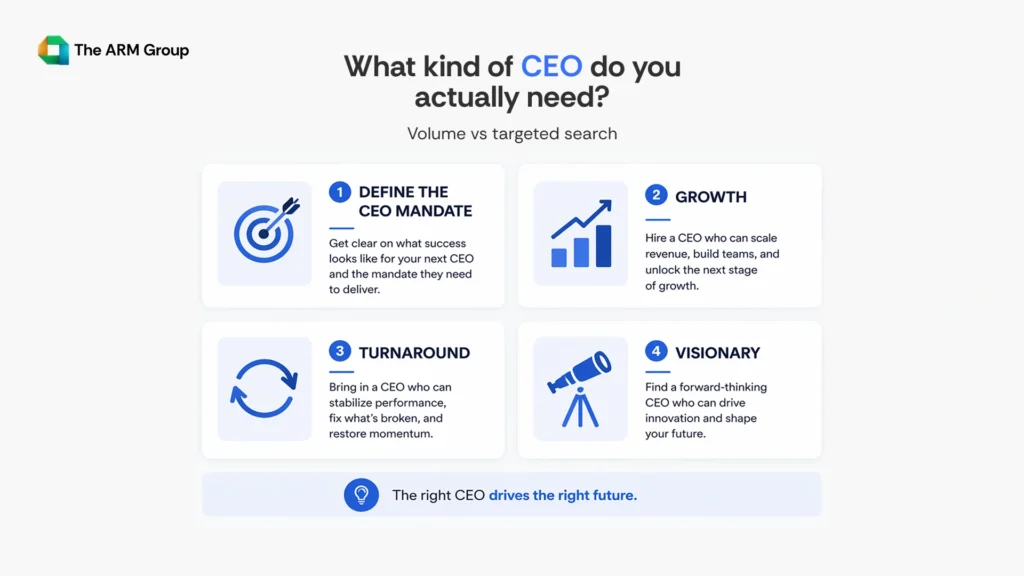
- Lack of Clarity on Expectations
Sometimes the real issue is not finding candidates. It is not clear what the business actually needs.
Do you need a growth CEO? A turnaround CEO? An operator? A founder-style leader? Clarity here changes everything.
- Too Many Choices
CEO hiring naturally includes multiple voices. But too many stakeholders without a clear process can slow progress.
- Misalignment Between Stakeholders
Investors, founders, and boards have different priorities when selecting leadership qualities that they want their organizations to exhibit. The factors lead to project delays during the final execution phases.
- Undecidedness
Strong CEO candidates are usually speaking with multiple organizations.
Slow decision-making can lead to the loss of top talent. In situations where leadership continuity is critical during a search, ARM Flexi can support interim and fast-turnaround executive hiring needs.
How to Choose the Right CEO Recruitment Partner?
Not every recruitment firm is equipped for a CEO search. This is where selection matters.
- Industry Understanding
Do they understand your business model and sector dynamics? This is often the biggest differentiator.
- Leadership Hiring Experience
Ask whether they have handled:
- CEO
- MD
- President
- COO-to-CEO transitions
Experience at this level matters.
- Structured Process
The process should be clear from discovery to closure.
Look for firms that can clearly explain:
- Sourcing
- Evaluation
- Stakeholder Alignment
- closure support
- Candidate Quality
Your business needs to assess relevant factors, not just the total number of available options. The organization selects candidates based on who will work best with its team, rather than choosing those who merely exist in the job market.
Specialized executive search partners outperform general hiring firms in CEO recruitment.
How does The Arm Group support CEO Hiring?
CEO hiring requires a balance between speed and precision.
The Arm Group focuses on:
- Leadership and C-level hiring through ARM Elite
- Industry-specific search through ARM Professional
- Structured leadership evaluation
- Targeted and relevant candidate sourcing
- Interim continuity and urgent support through ARM Flexi
The organization focuses on identifying suitable leaders who can meet both business goals and leadership requirements, rather than distributing multiple candidate profiles.
It improves hiring certainty by identifying executive candidates who meet the established requirements.
FAQs
How long does CEO hiring take?
It varies by industry and business stage, but it usually takes longer than standard hiring processes due to multiple evaluation stages and stakeholder reviews.
Do CEO recruitment agencies only work with large companies?
No. They also work with startups, scale-ups, mid-sized businesses, and founder-led organizations.
Is the CEO hiring differently across industries?
Yes. Industry expectations significantly affect the leadership profile, evaluation criteria, and final selection.
Why is CEO hiring often slower?
It involves fewer candidates, more stakeholders, and a much higher cost of a wrong hire.
Conclusion
CEO hiring is one of the most important decisions a company will ever make. It doesn’t simply fill a senior role.
It is about choosing the person who will shape strategy, culture, performance, and long-term growth. The right CEO recruitment partner brings clarity to this decision by combining market insight, structured search, and leadership evaluation.
When done well, the process does not just fill a role; it serves a purpose. It sets the direction for the business moving forward.
Get The Arm Group to discuss the right executive-hiring approach if your organization is preparing for a CEO transition or a confidential leadership search.
Key Takeaways:
- CEO hiring is significantly more complex than standard recruitment.
- Industry context plays a major role in defining the right leadership profile.
- Stakeholder alignment is critical to avoid delays.
- Structured search improves decision-making and role fit.
- Specialized CEO recruitment agencies usually deliver stronger outcomes.

Kiran Kumar Naik
Kirankumar Naik is a Client Partner (Business Development Manager) at The ARM Group, where he helps product- and service-based companies scale their teams by connecting them with the right talent. His expertise spans lead generation, marketing, and sales, and he thrives on building long-term partnerships that drive business growth. Focused on deeply understanding client needs, Kirankumar delivers solutions that make a real impact — turning complex hiring challenges into win-win outcomes for clients and candidates alike, across leadership, lateral, and contract hiring worldwide.