


Your VP of Operations just resigned on a Tuesday. No warning. The project that ships next quarter needed them. You post the role on LinkedIn by Friday, and within two weeks, you have 140 applicants. None of them is right. Not even close.
That is when most companies realize they have been thinking about senior hiring the wrong way. Posting a job and waiting is a junior hire strategy. Finding a VP, a Director, or a C-suite leader requires something entirely different. It requires someone who is not waiting to be found.
That is what executive recruiter firms actually do. And most people only half-understand it.
What Executive Recruiter Firms Actually Do
Most people assume executive recruiter firms are just fancier job boards. You tell them what you need. They send you CVs. You pick one.
That is not even close to how it works.
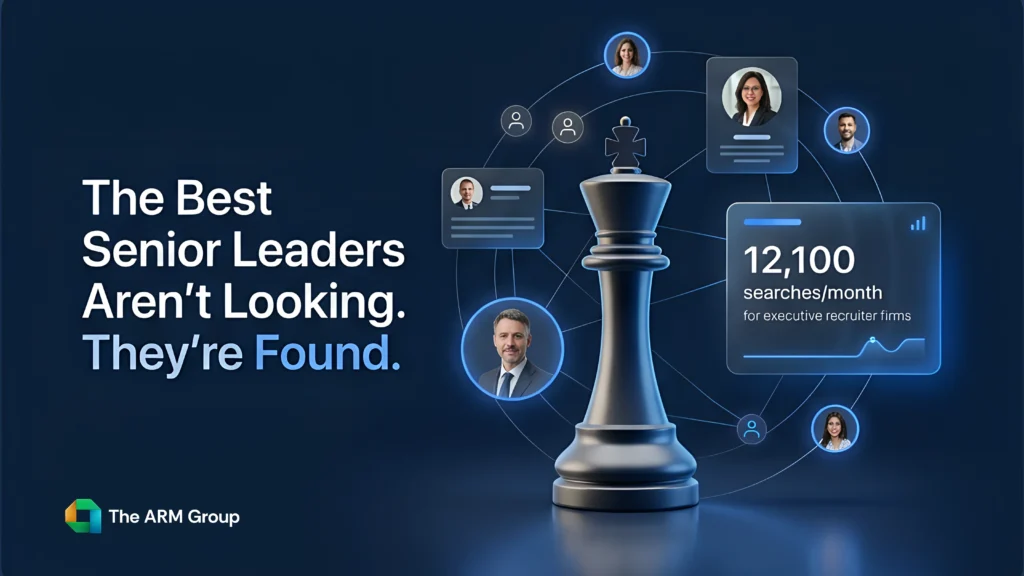
Executive recruiting firms operate more like investigators than HR departments. They are not waiting for candidates to come to them. They are actively mapping the market, identifying people who are currently employed, currently thriving, and not thinking about leaving at all. And then they approach those people with the right conversation at the right moment.
The formal name for this is talent mapping. In practice, it means a firm builds an intelligence picture of every strong potential candidate in a given function and industry before a single email gets sent. Leadership teams across competitors are analyzed. Career trajectories get studied. The actual shortlist you receive at the end was never a pool of applicants. It was a curated result of weeks of targeted research.
According to SHRM’s 2025 Benchmarking Report, the average cost per hire at the executive level is roughly $39,000. That covers the search. What it does not cover is the downstream cost of a wrong hire. A failed executive hire can run anywhere from 5 to 27 times the individual’s annual salary, once severance, lost momentum, and the second search cycle are factored in.
Executive recruiting firms exist precisely because that kind of failure is expensive enough to justify a real investment up front.
Why Senior Leaders Don’t Apply to Job Posts
Here is something that changes how you think about this entire process.
The best candidates for your open VP or C-suite role are probably not looking. They are running something right now. They are delivering results at a competitor. They are heads down on a transformation project that has their full attention.
These are passive candidates, and they make up the overwhelming majority of qualified senior talent. Research from executive search firms consistently shows that between 60% and 80% of senior hires come from passive outreach rather than active applicants. A job post on LinkedIn or Indeed does not reach these people. It reaches the ones who are already searching.
This is the structural gap that executive headhunter firms were built to fill. They have the networks, the research infrastructure, and the relational credibility to approach someone who is not looking and have a conversation worth having. A recruiter at a firm like this is not cold-calling. They are reaching out with genuine industry knowledge, a role that aligns with the candidate’s trajectory, and the discretion required for a high-stakes conversation.
A manufacturing company, The ARM Group, once told its team the same thing: their biggest hiring mistake was not choosing the wrong recruiter. It was waiting too long to start the search. By the time they engaged, they were already behind. The best candidates for their Director of Operations role had quietly accepted other offers the month before.
The Search Process, Stage by Stage
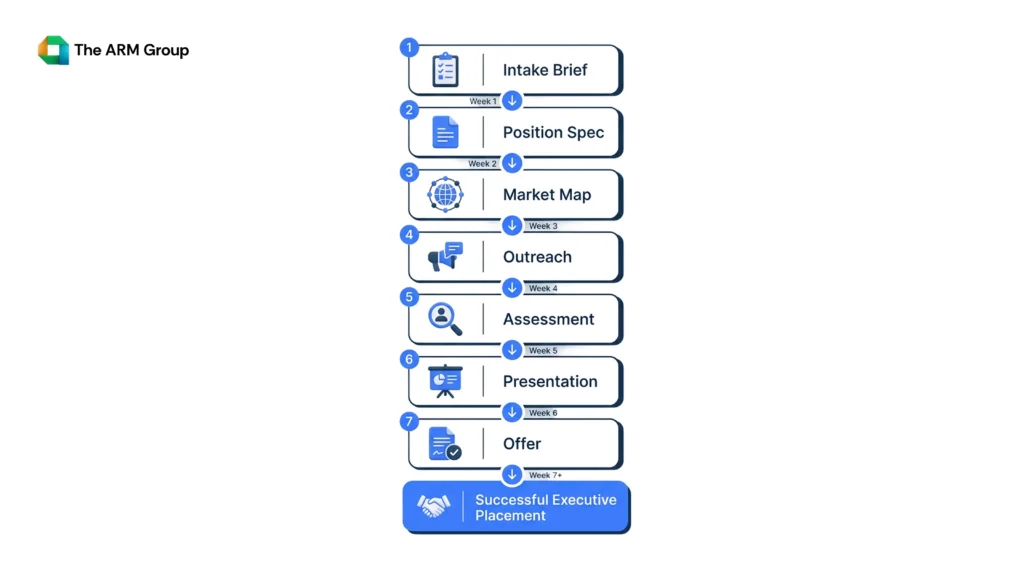
Understanding how the process actually runs helps you evaluate firms better and set realistic expectations. The typical executive search process moves through seven stages.
Intake brief. The firm spends real time with your leadership team. Not just reviewing a job description, but understanding the business problem the hire needs to solve, the culture they need to operate in, and the political landscape they will walk into.
Position specification. A detailed document is built that goes well beyond the job spec. It captures success metrics, leadership-style requirements, stakeholder relationships, and the context in which the role sits. This is what the search runs against.
Market research and talent mapping. Researchers build a long list of potential candidates by analyzing competitors, adjacent industries, and leadership networks. This phase is invisible to the client, but it is the entire foundation of a quality shortlist.
Candidate outreach. The firm approaches targets directly and confidentially. These conversations are nuanced. The best firms are not pitching a role. They are exploring whether there is a genuine fit worth pursuing further.
Assessment. Structured interviews, competency frameworks, and reference checks narrow the long list to a shortlist of typically four to six candidates. Psychometric tools are often used at this stage as well.
Client presentation. The shortlist is presented with a full brief on each candidate, including the recruiter’s assessment of strengths, development areas, and fit.
Offer negotiation and onboarding support. The firm manages the negotiation and often remains engaged for the first 90 days to protect the placement.
<> Firms using AI-assisted sourcing have brought average C-suite search timelines down from around 14 weeks to closer to 9 weeks in 2026, according to recent market data. More complex searches, such as board-level or CEO roles, can still take 20 weeks or longer.
Retained vs. Contingency: The Model That Changes Everything
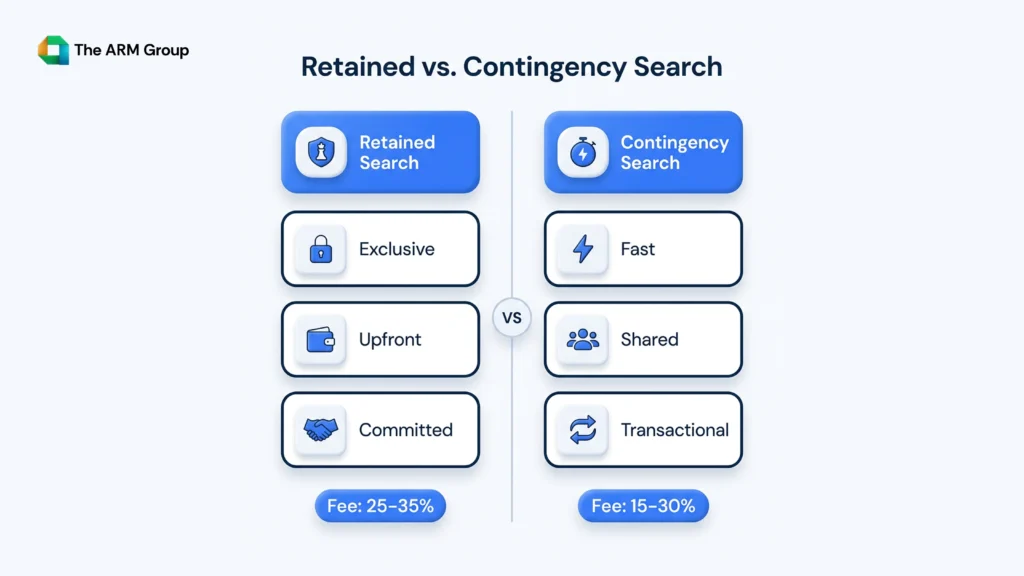
This is the part most hiring teams do not fully think through before engaging a firm. And it is the decision that determines the quality of what you get.
Retained executive search means you pay a portion of the fee upfront. The firm works exclusively on your search. Their researchers and consultants are committed to your role and only your role. The fee typically runs 25% to 33% of the placed executive’s first-year total compensation, split across three milestones: engagement, shortlist delivery, and offer acceptance.
Contingency search means you pay nothing until a hire is made. The firm works on your role alongside dozens of others, with no exclusivity. They prioritize the searches most likely to close quickly, not necessarily yours.
For a VP of Sales or a Director of Finance, the retained model is almost always the better call. The stakes are simply too high for a transactional approach.
One more thing worth knowing: the contingency model creates a structural problem that rarely gets talked about. A contingency recruiter working 50 open roles simultaneously has an incentive to move fast, not to move right. The best candidates, the ones who need time and a thoughtful conversation, often get passed over in favor of whoever is already on the market.
What Executive Headhunter Firms Cost (And Why It’s Worth It)
The fee range for retained executive search runs from 25% to 38% of first-year total compensation. That includes base salary, guaranteed bonuses, and sometimes equity, depending on how the engagement letter is written.
On a $250,000 package, you are looking at a fee between $62,500 and $95,000. For a $400,000 package, the math comes out to between $100,000 and $150,000. Top-tier global firms typically apply a minimum floor of $75,000 to $100,000 regardless of the percentage.
That number can feel large when you are looking at it in isolation. It looks very different when you compare it to the cost of a failed hire. Research cited in the Harvard Business Review puts the cumulative cost of a failed executive hire at up to 10 times the executive’s annual salary, once severance, second-search costs, and strategic disruption are factored in.
An engagement with the right executive recruiting firm is not an expense. It is risk management.
The Red Flags When Choosing a Firm
Not every executive recruiter firm runs the same quality of process. Some signals tell you quickly whether the firm you are evaluating is the real deal or not.
They can not name recent placements in your industry. A firm that has placed a CFO in manufacturing and a VP of Engineering in pharma thinks differently about leadership than a generalist firm. Industry context matters enormously at the senior level.
They are vague about their research methodology. A good firm can walk you through exactly how they map a market, how they build the long list, and what their assessment framework looks like. Vague answers here are a red flag.
They want to present your role publicly before understanding it. The entire value of the retained model is confidentiality and specificity. If a firm is moving straight to a job posting without a real intake process, they are running a contingency model wearing retained clothes.
They can not be specific about the timeline. An average executive search runs 9 to 16 weeks for most senior roles. A firm that promises four weeks or hedges completely on timing is worth scrutinizing further.
Why Companies Working Across Borders Need a Specialized Partner
For Indian companies expanding into the US market, or for businesses running hiring operations across multiple geographies, the complexity multiplies fast.
Compensation benchmarks are different. Candidate expectations around remote work, equity, and notice periods vary significantly. The cultural nuances that make a leader effective in one market do not automatically transfer to another.
This is where a firm with genuine cross-border operational experience, not just a global list of contacts, changes the outcome. The right partner understands how to position a role in a way that makes sense for a US-based senior hire, while also aligning with the organizational culture and expectations of a company headquartered in another market.
The Bureau of Labor Statistics consistently shows that demand for senior leadership roles across manufacturing, IT, pharma, and financial services outpaces supply in the US. Getting ahead of that gap with the right recruitment partner is the difference between a twelve-week search and a six-month one.
Why The ARM Group Is the Right Executive Search Partner for Your Business
When a senior role opens up, the pressure is immediate. Business decisions get deferred. Teams look for direction. The cost of a long vacancy is not theoretical. It is felt every week the seat stays empty.
The ARM Group was built specifically for this moment. With 100+ years of combined recruiting experience across a team operating in the US and India, The ARM Group works with employers who need more than a resume shortlist. They need a partner who understands the industry, the role, and what leadership actually looks like in their specific context.
ARM Elite is The ARM Group’s dedicated executive and leadership search service, designed for C-suite, VP, and Director-level placements. The process runs from intake to offer, with curated shortlists and rigorous screening at every stage. For companies that need senior leadership placed quickly and confidently, ARM Elite delivers candidates who are vetted, offer-ready, and right for the role. For growing organizations with mid- to senior-level hiring needs across functions, ARM Professional provides the same structured, relationship-driven approach used for the broader leadership pipeline.
What sets The ARM Group apart from a generic executive recruiting firm is its cross-border operational model. India headquarters, US execution. That means an Indian company expanding its US operations does not need to build an in-house US HR team to run a credible executive search. The ARM Group manages the full cycle, with genuine market knowledge on both sides. With 85+ global clients across 27+ countries and pre-vetted shortlists delivered within 24 to 48 hours, the search does not drag on. It moves.
Frequently Asked Questions
How do executive recruiter firms find candidates for senior roles?
Executive recruiting firms use talent mapping, direct outreach, and proprietary networks to identify passive candidates who are not actively looking. They analyze competitor organizations, build long lists of potential targets, and approach them with confidential, research-backed conversations before ever presenting a shortlist.
What is the difference between retained and contingency executive search?
Retained search means the firm is paid upfront and works exclusively on your role with full commitment. Contingency search is pay-on-placement only, but the firm works multiple searches simultaneously. For senior and C-suite roles, retained search almost always delivers better quality outcomes.
How long does an executive search typically take?
Most retained executive searches run 9 to 16 weeks from intake to accepted offer. Searches using AI-assisted sourcing have brought that average closer to 9 weeks in 2026. Board-level or CEO searches can extend to 20 weeks or longer, depending on the role complexity.
What do executive headhunter firms charge?
Retained executive search fees typically run 25% to 33% of the placed executive’s first-year total compensation, paid across three milestones. Contingency fees are similar in percentage terms but are paid only upon placement. Top-tier firms often apply minimum floors of $75,000 to $100,000.
When should a company use an executive recruiting firm instead of hiring in-house?
When the role is at the VP level or above, when the ideal candidates are passive and not actively looking, when confidentiality is required (such as replacing a sitting executive), or when the hiring company lacks the market intelligence and networks to run a thorough search independently.
Does The ARM Group handle executive searches across industries?
Yes. The ARM Group recruits across 15+ industry verticals, including Manufacturing, IT, Pharma, Banking, Logistics, Energy, Aviation, and Financial Services, for roles ranging from Director- and VP-level through to C-suite. ARM Elite is their dedicated senior search service.
Can Indian companies use an executive recruiter firm for US hires?
Absolutely. Firms with cross-border operational models, such as The ARM Group, are specifically built to help Indian companies expand into or hire in the US market without needing an in-house US HR team. They manage the full search cycle with US market knowledge and coordination on the India side.
Conclusion
Executive recruiter firms are not a shortcut. They are the methods that senior hiring actually requires. When the role is critical, the timeline matters, and the wrong hire carries a real organizational cost, the right firm changes the outcome in a way that a job post simply cannot.
The leaders who will drive your next phase of growth are probably not sitting in anyone’s inbox right now. They are already somewhere, delivering results for someone else. Finding them takes research, relationships, and the kind of deliberate process that executive recruiting firms were built to run.
Key Takeaways
- Executive recruiter firms are not job boards. They actively identify and approach passive candidates who are not looking.
- The best candidates for senior roles are already employed somewhere. Direct outreach is the only way to reach them.
- Talent mapping is the invisible foundation of every strong executive shortlist.
- The retained search model delivers better quality for senior roles because the firm’s commitment is not contingent on a fast close.
- Retained executive search fees run 25% to 33% of first-year total compensation, structured across three payment milestones.
- A failed executive hire can cost 5 to 27 times the individual’s annual salary when full downstream impact is calculated.
- The full search process runs 7 stages, from intake brief through onboarding support.
- AI-assisted sourcing has brought average C-suite search timelines down from 14 weeks to around 9 weeks in 2026.
- Cross-border searches require a firm with genuine operational experience on both sides, not just a global contact list.
- Engaging the right firm early is the difference between a focused 10-week search and a six-month scramble.
Ready to find the senior leader your team needs? Talk to The ARM Group today at thearmgroup.org/contact-us/ and get a pre-vetted shortlist in 24 to 48 hours.

Bhargav C Rob
Bhargav C — who goes by “Rob” — serves as AVP of Global Recruitment Operations at The ARM Group, overseeing hiring across three continents and 50+ countries. Over 15+ years he has scaled teams, placed senior leaders, and built employer brands that attract high-caliber talent. He leads recruiters who go beyond filling roles to shaping the companies they hire for, bringing deep expertise in global talent acquisition, applicant tracking systems, and strategic sourcing. Whether he's between airports or on back-to-back Zoom calls, Rob thrives on the round-the-clock rhythm of global hiring.