


Did you know that a typical C-suite and executive search takes about 8 to 12 months to complete? This is roughly 60% more hours than the usual mid-level hires!
A single hire can make or break your organization’s productivity. This is why so many businesses invest so much time and resources in finding the right executives. Any wrong leadership decision can quickly result in costly setbacks and missed opportunities for your business.
Most businesses rely on hiring partners like The Arm Group to fill senior leadership positions. They help in finding and attracting the top-level talents, followed by thorough examination strategies. All the processes are confidential and research-driven, ensuring you get the best fit for the role. Let’s learn more about it.
What is an Executive Search Firm?
An executive search firm is a specialized recruitment organization that helps companies identify, attract, assess, and hire senior-level professionals for critical leadership positions. These roles typically include:
- Chief Executive Officer (CEO)
- Chief Financial Officer (CFO)
- Chief Operating Officer (COO)
- Chief Technology Officer (CTO)
- Vice Presidents
- Directors
- Board Members
- Other senior leadership positions
It is not just about filling vacancies here. It is more about finding the right leader who can actually create long-term value for the organization.
What Does An Executive Search Firm Do?
An executive search firm ensures that you always have someone to rely on when it comes to filling the leadership roles for your organization. These responsibilities include:
- Understanding Business Needs
Before initiating a search, consultants work closely with organizational leaders to understand:
- Business objectives
- Company culture
- Leadership challenges
- Team structure
- Future growth plans
This helps establish a clear candidate profile that goes beyond technical qualifications.
- Conducting Market Research
Market research helps to identify the best talent within competitor organizations and related sectors. This provides immensely valuable market intelligence and a wider talent pool.
- Reaching Passive Candidates
So many top-performing executives are already looking to switch jobs, but do not really post about their availability. In such cases, executive search firms can use their networks and direct outreach to quickly engage with these candidates and fill the role.
- Evaluating Leadership Potential
Candidate evaluation often includes:
- Leadership assessments
- Behavioral interviews
- Reference checks
- Career achievement reviews
- Cultural fit analysis
The goal is to determine not only whether someone can perform the job but also whether they can thrive within the organization’s environment.
- Managing Negotiations
Executive search firms also facilitate compensation discussions, offer negotiations, and provide onboarding support to ensure a smooth transition.
How Does The Executive Search Process Work?
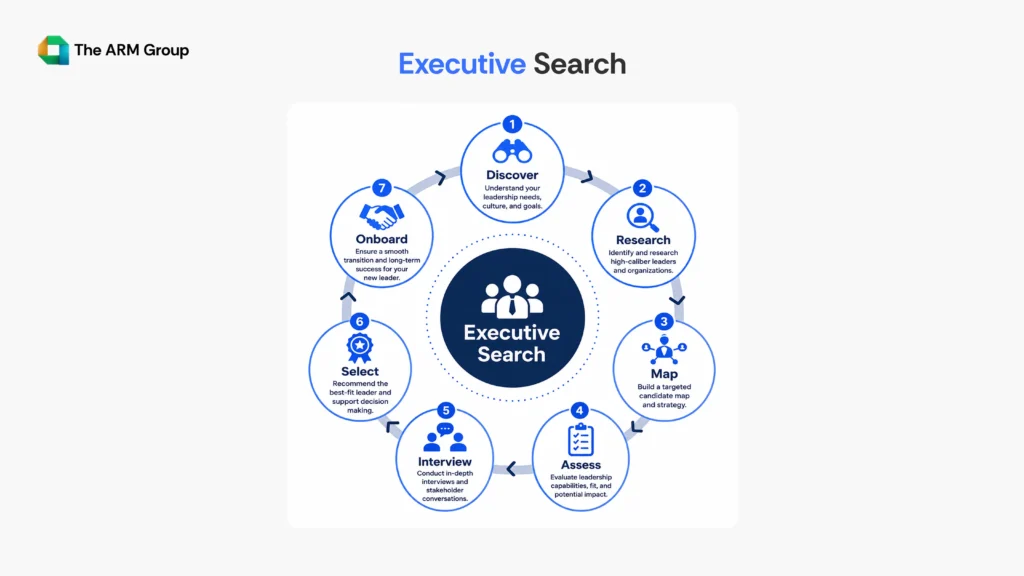
[Visual 1]: Inside The Executive Search Process
Understanding the process in detail will help you set realistic expectations and a timeline throughout. Here’s a quick brief about the executive hiring process.
- Step 1: Discovery And Position Definition
The process begins with detailed discussions between the client and search consultants.
Key topics include:
- Business goals
- Leadership expectations
- Required competencies
- Reporting relationships
- Success metrics
A comprehensive position specification is then developed.
- Step 2: Market Mapping And Research
The search team identifies potential talent sources and develops a target list of candidates.
This stage often involves:
- Industry analysis
- Competitor research
- Talent mapping
- Compensation benchmarking
- Step 3: Candidate Outreach
Consultants discreetly contact qualified candidates and introduce the opportunity. Because many candidates are currently employed, outreach must be personalized and confidential.
- Step 4: Candidate Assessment
Interested candidates undergo a thorough evaluation process.
Assessment methods may include:
- Structured interviews
- Leadership competency reviews
- Career history analysis
- Reference validation
This stage helps narrow the field to a highly qualified shortlist.
- Step 5: Client Interviews
Selected candidates meet with key stakeholders within the hiring organization. Feedback is collected and discussed to determine alignment between candidate capabilities and organizational needs.
- Step 6: Final Selection And Negotiation
Once a preferred candidate is identified, the executive search firm assists with:
- Offer preparation
- Compensation negotiations
- Resignation management
- Transition planning
- Step 7: Onboarding Support
Many firms continue to support both the client and the candidate during the onboarding period to improve retention and long-term success.
When Should Companies Use Executive Search Services?
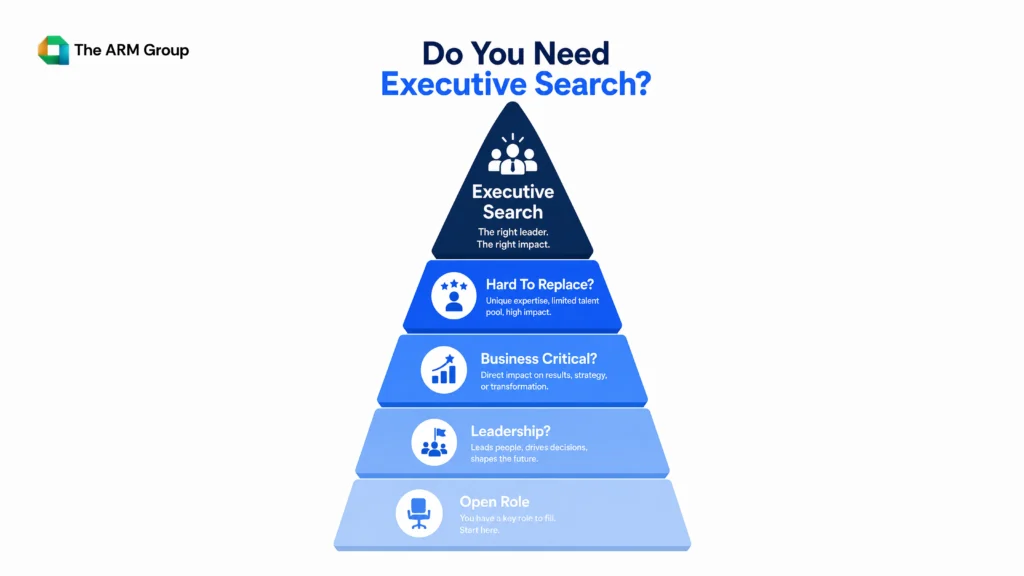
Not every role requires executive search.
However, organizations often benefit from these services when hiring for:
- Senior Leadership Positions
Executive search is ideal for:
- C-suite executives
- Vice Presidents
- General Managers
- Directors
- Board members
- Confidential Replacements
When an organization needs to discreetly replace a current executive, executive search provides a secure and confidential process.
- Specialized Leadership Roles
Some positions require rare expertise or niche industry experience. Executive search firms excel at locating highly specialized candidates.
- Rapid Growth Initiatives
Companies undergoing expansion often need leaders capable of scaling operations and managing change.
- Succession Planning
Organizations preparing for leadership transitions frequently engage executive search professionals to identify future leaders before vacancies occur.
How The ARM Group Helps Organizations Hire Top Talent?
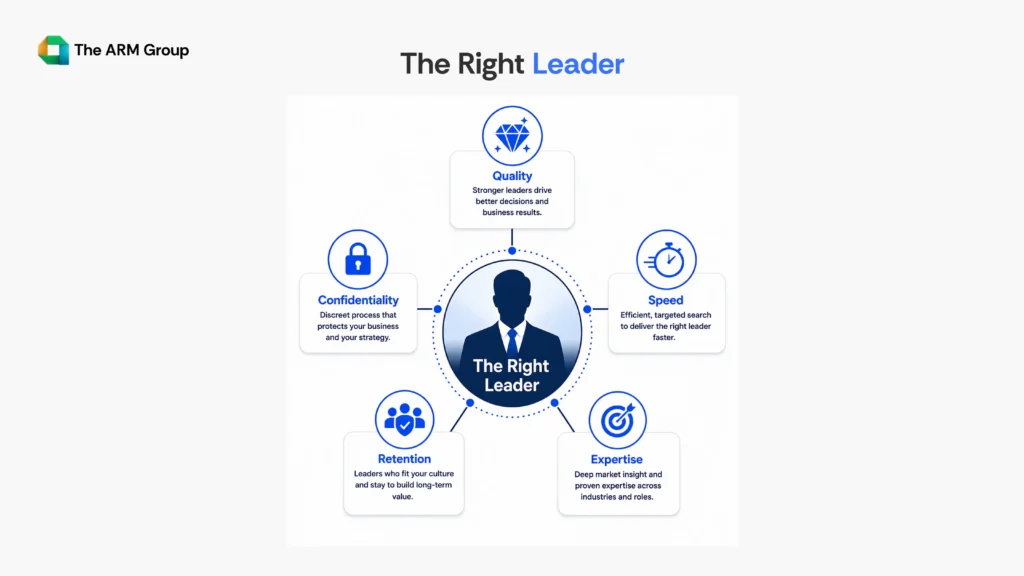
Finding the right talent for executive roles is never easy. It requires immense effort to identify, schedule interviews, conduct thorough assessments, and more. The Arm Group helps overcome these challenges through carefully crafted strategic recruiting and staffing solutions that are aligned with your business goals.
Here’s more about their services in brief.
- Understand business objectives, team dynamics, company culture, and specific hiring requirements to develop a clear picture of the type of candidate who will succeed in the role and contribute positively to the organization’s long-term goals.
- Identify qualified candidates through targeted sourcing strategies that leverage industry networks, talent databases, referrals, and proactive outreach methods to connect employers with professionals who possess the right skills, experience, and career aspirations.
- Conduct thorough candidate screening and evaluation processes that assess not only technical qualifications and professional achievements but also communication abilities, leadership potential, and overall alignment with the company’s culture and values.
- Coordinate interviews, manage candidate communications, and facilitate the hiring process from start to finish, helping employers save valuable time while ensuring a positive experience for both hiring managers and prospective employees.
- Support successful candidate placements by maintaining communication throughout the offer and onboarding stages, helping organizations and new hires establish a strong foundation for long-term success and retention.
This comprehensive approach allows organizations to significantly streamline their hiring efforts, minimize recruitment challenges, and secure professionals who can make an immediate yet lasting impact on their business performance.
With the right industry knowledge, extensive talent networks, and best recruiting methodologies, they can actually find the top talent for your organization.
FAQs
What is an executive search firm?
An executive search firm is a specialized recruiting outfit that helps businesses find and hire senior-level leaders such as CEOs, CFOs, Vice Presidents, Directors, and the like, using targeted and confidential search methods.
How does the executive search process work?
The process usually goes like this: define the role, conduct market mapping, build a candidate outreach list, then a leadership assessment, followed by client interviews, offer negotiation, and some onboarding support.
How is an executive search firm different from a recruitment agency?
An executive search firm mainly focuses on leadership roles and often works with passive candidates, while a recruitment agency usually handles broader hiring needs, draws from more active candidate pools, and yeah, it’s more general.
When should a company hire an executive search firm?
A company may want executive search help when it’s hiring for senior leadership roles, handling confidential replacements, considering succession planning, or when the position requires specialized expertise and the stakes are high.
What are the benefits of using an executive search firm?
Key benefits are access to passive candidates, better quality of hire, lower hiring risk, stronger confidentiality, plus useful market intelligence that you don’t always get otherwise.
Are executive search firms only for large companies?
No. Small and mid-sized companies often use executive search services when they need leaders who will meaningfully affect business performance or drive growth.
Can direct hire firms and executive search firms work together?
Yes, direct-hire firms can handle permanent hiring across different roles, while executive search firms focus on more strategic leadership roles. Together, they form a more complete talent acquisition plan, not just one-off hiring.
Conclusion
Understanding the importance and what goes behind when searching for the right executives is truly important. Executive search firms are more inclined to use a strategic, research-driven approach rather than traditional hiring strategies. This reduces the overall risk and improves leadership quality for the business.
At the Arm Group, the focus is more on designing executive hiring processes that can drive long-term business success. With careful assessment and the attraction of the right talent, executive search becomes much easier and more manageable, resulting in greater efficiency.
Key Takeaways
- Executive search firms tend to specialize in recruiting senior leaders and other key decision-makers, the ones who really can steer where an organization goes next. And it’s not just about filling vacancies, more like spotting durable leadership solutions before a problem even shows up in the org chart.
- Usually, the process looks like discovery first, then market research. After that comes candidate outreach, followed by assessment and interviews. Then there’s negotiation, and yes, onboarding support too. The whole idea is that each step helps dial in better hiring accuracy and a more natural leadership fit.
- Executive search also feels a bit different from traditional recruitment, because it often targets passive candidates and runs on a highly discreet, consultative approach. That’s why it’s so useful when the hiring need is strategic and maybe even sensitive.
- Direct-hire firms and executive search firms can actually work together. In practice, they complement each other by supporting different hiring objectives, not just the same slot. So with the right mix, organizations can build stronger teams across just about every level.
- Picking the right search partner isn’t something to rush. You’re basically evaluating their industry expertise, the methodology they use, the strength of their network, and how well they understand the culture. When that partnership clicks, hiring outcomes improve significantly, and long-term retention tends to improve, too.

Mehak Arora
Mehak Arora is a Talent Acquisition and Human Resources professional at The ARM Group, specializing in connecting top talent with organizations that thrive on innovation and excellence. With over three years in the industry, she has developed a deep understanding of talent acquisition strategy, workforce planning, and employer branding. Whether she is sourcing niche candidates, streamlining recruitment operations, or enhancing the candidate experience, Mehak is driven by aligning the right talent with the right opportunities — and by helping companies grow through their most valuable asset, their people. She is frequently singled out in candidate testimonials for her exceptional, proactive guidance throughout the hiring process.