

A revenue target is not a hiring plan. A workforce planning strategy converts business demand into roles, skills, capacity, timing, cost, and sourcing decisions. It shows what work must be delivered, which capability already exists, which gaps must be closed, and whether the answer is hiring, development, redeployment, automation, or flexible staffing.
The plan should also include more than one future. The U.S. Bureau of Labor Statistics projects total employment to grow by 5.9 million from 2025 to 2035, but industry patterns vary widely. Employers need role-level scenarios, not one national assumption.
Key Takeaways
- Start with business outputs and capacity drivers before requesting headcount.
- Model a base case, growth case, and downside case with explicit triggers for each hiring action.
- Separate headcount gaps from skill gaps, because training, redeployment, contract talent, and permanent hiring solve different problems.
- Add recruiting lead time, notice period, onboarding, and productivity ramp to the date when capacity is actually needed.
- Review the plan quarterly and whenever demand, attrition, technology, location, or operating model changes materially.
What Should a Workforce Planning Strategy Produce?
The output should be a timed action plan, not a headcount spreadsheet. For each capability, it should identify demand, current supply, the gap, the chosen response, cost, owner, start date, decision trigger, and review date.
Use the BLS Employment Projections to understand national occupation and industry direction, then test that evidence against local pay, availability, attrition, productivity, and business demand. The O*NET database can help employers define the tasks, skills, knowledge, and work context attached to U.S. occupations.
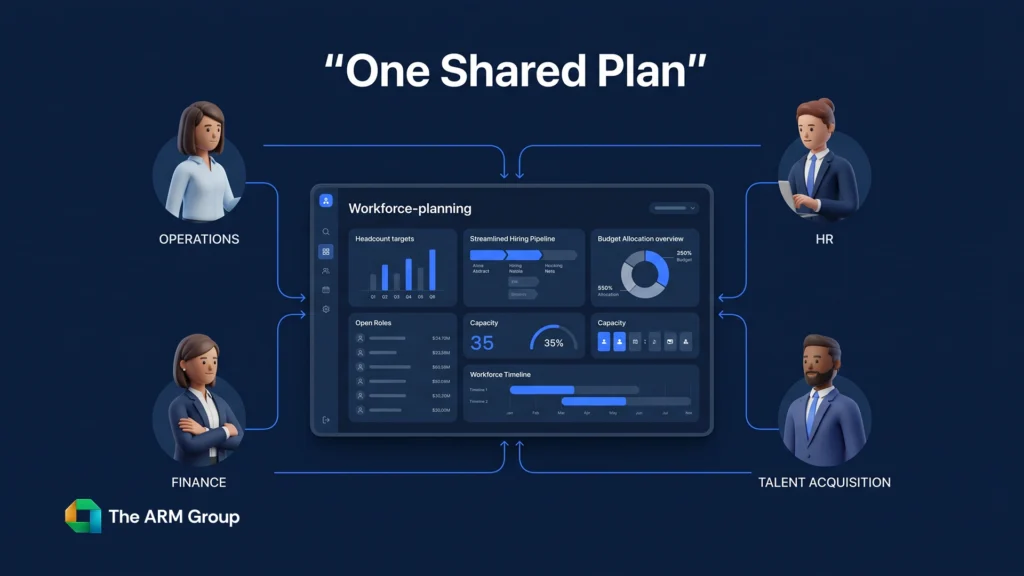
A complete plan connects finance, operations, HR, and talent acquisition. Finance validates affordability. Operations defines the work and productivity assumptions. HR identifies internal capability and retention risk. Talent acquisition tests whether the required people can realistically be found by the needed date.
How Do You Translate Business Growth Into Workforce Demand?
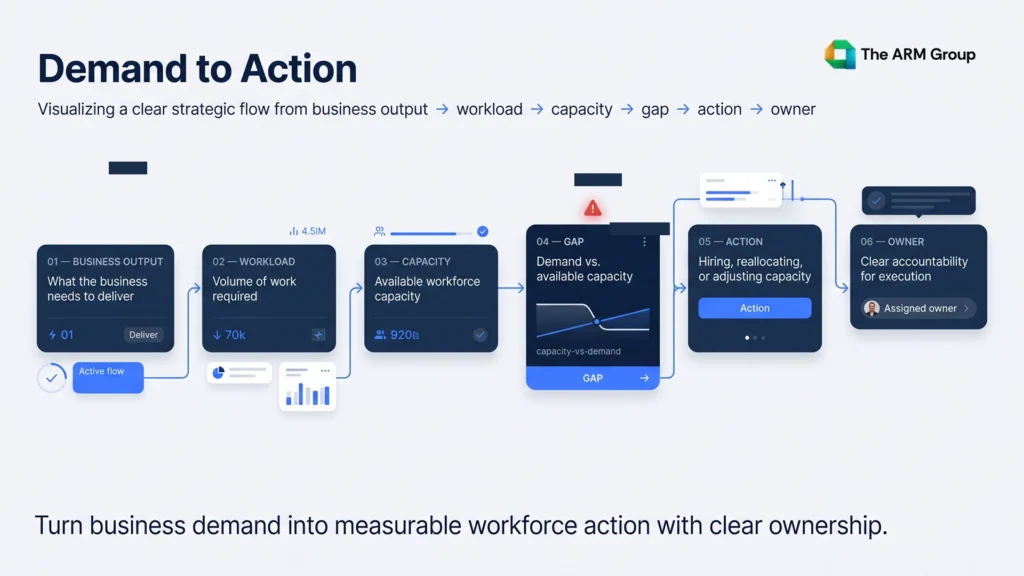
Translate each business objective into workload, then convert workload into capacity. If a manufacturer plans a second shift, the driver may be units, operating hours, line staffing, maintenance coverage, and quality checks. If a software company launches a product, the drivers may be roadmap scope, support volume, release cadence, and service levels.
Use this sequence:
- Define the business output and deadline.
- Identify the work packages required to deliver it.
- Estimate workload for each package.
- Calculate available productive capacity, allowing for leave, training, maintenance, and ramp time.
- Identify the remaining role and skill gap.
- Test the assumption with the manager who owns the work.
For industrial employers, The ARM Group’s manufacturing workforce solutions can support planning for greenfield projects, plant expansions, contract ramps, and long-term hiring.
How Do You Audit Current Workforce Supply?
A supply audit measures usable capability, not only employees on payroll. Record role, location, employment model, proficiency, certifications where relevant, availability, shift coverage, mobility, retirement or exit risk, and readiness for a larger role.
Avoid rating everyone with vague labels such as beginner, intermediate, and advanced. Define observable evidence for each capability. For example, a maintenance technician may be qualified to diagnose one equipment family but need training before supporting a new automated line.
Map internal mobility and succession separately from external hiring. Some gaps can be closed through development or redeployment, while others require market access. ARM Professional supports targeted recruitment for skilled roles when internal supply is insufficient.
How Do You Build Three Workforce Scenarios?
Create a base case, growth case, and downside case using the same demand drivers. Different assumptions should change the numbers, timing, and workforce model, not the planning method.
| Scenario | Trigger | Workforce Response | Commitment Level |
| Base case | Approved operating plan remains on forecast | Fill critical permanent gaps and develop internal successors | Planned |
| Growth case | Orders, customers, funding, or capacity usage crosses an agreed threshold | Start sourcing early, add contract capacity, and phase permanent hires | Staged |
| Downside case | Demand falls below an agreed threshold | Pause lower-priority requisitions, redeploy skills, and limit fixed additions | Controlled |
Assign a date and owner to every trigger. A scenario with no decision rule is only a narrative. For cross-border expansion, include entity setup, location choice, compensation, notice periods, leadership availability, and onboarding dependencies. The cross-border hiring service focuses on U.S.-India recruitment requirements.
How Do You Choose the Right Workforce Action?
Choose the response according to duration, scarcity, business criticality, and uncertainty. Permanent hiring fits enduring work and capabilities the organization must own. Contract or temporary staffing fits peaks, projects, absence, uncertain demand, and staged capacity. Development fits gaps where internal employees can become ready before demand arrives.
Redeployment can solve a location or demand mismatch, while redesign or automation may remove low-value work. These are not interchangeable. A scarce leadership role may require ARM Elite executive search, while a seasonal production increase may fit ARM Flexi.
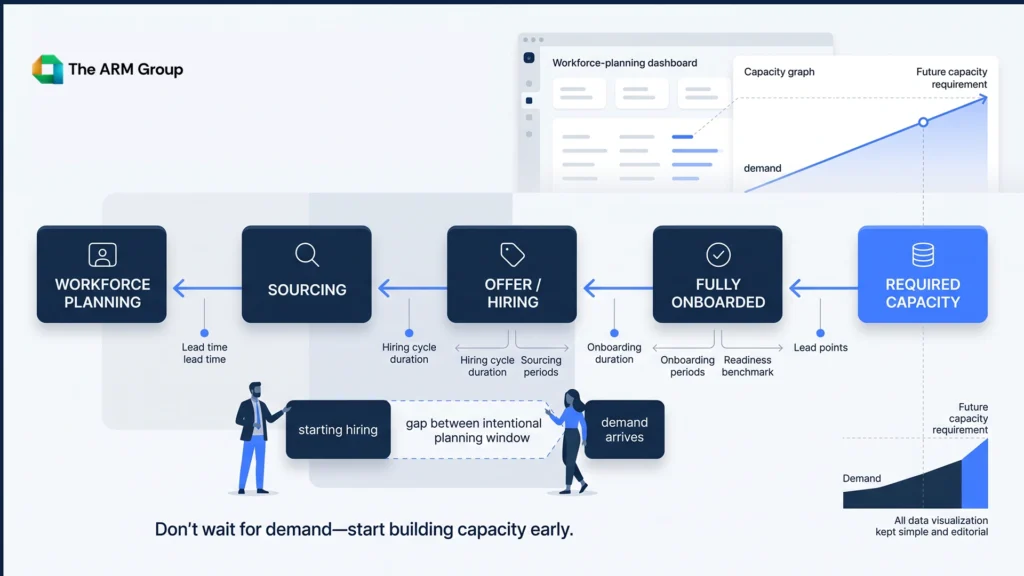
Add the complete lead time. If capacity is needed on 1 January, subtract approval, sourcing, assessment, offer, notice, onboarding, and productivity-ramp time. The requisition date may need to fall months earlier.
Which Metrics and Owners Keep the Plan Active?
Each workforce action needs one accountable owner and a review rhythm. Track forecast versus actual demand, capacity coverage, vacancy age, offer acceptance, joining rate, new-hire retention, internal fill rate, critical-skill coverage, overtime, contractor dependency, and workforce cost against plan.
Review operating indicators monthly and the full scenario set quarterly. A major contract, plant expansion, funding change, technology rollout, acquisition, or unexpected attrition spike should trigger an immediate review.
The latest BLS employment projections release shows why the occupational mix matters: growth is concentrated in particular industries and occupations. A national headcount trend cannot replace a role-specific talent-market review.
What Workforce Planning Failures Should Employers Avoid?
The most common failure is starting with an approved number of positions instead of the work that must be delivered. That approach preserves old structures even when skills, technology, and customer demand have changed.
Other failures include using one forecast, ignoring attrition, treating every gap as an external hire, leaving recruiters out until approval, omitting onboarding time, and planning each department in isolation. Plans also fail when nobody records triggers or owns the decision.
Talk to The ARM Group about the recruitment model that fits your growth plan, skill gaps, locations, and hiring timeline.
FAQs
What Is a Workforce Planning Strategy?
A workforce planning strategy is a repeatable method for matching future business demand with the required people, skills, capacity, location, timing, and cost. It produces decisions and owners, not only forecasts.
How Far Ahead Should Workforce Planning Look?
Use multiple horizons. Many employers need a near-term operational view, an annual budget view, and a two-to-five-year capability view, adjusted to the speed and predictability of their industry.
Who Owns Workforce Planning?
Business leadership owns the outcome, with finance, operations, HR, and talent acquisition contributing different inputs. One named leader should coordinate assumptions and decisions.
What Data Is Needed for Workforce Planning?
Useful inputs include business demand, workload, productivity, headcount, skills, attrition, mobility, compensation, vacancy lead time, absence, overtime, and labor-market availability. The exact set depends on the decision.
What Is the Difference Between Headcount Planning and Workforce Planning?
Headcount planning focuses on the number and cost of positions, while workforce planning also considers skills, capacity, timing, location, work design, and employment model. Headcount is one input to the wider process.
How Often Should the Workforce Plan Be Updated?
Review operating indicators monthly and the full plan at least quarterly. Update it sooner when a major business assumption changes.
When Should a Company Use Flexible Staffing?
Flexible staffing fits temporary, seasonal, project-based, uncertain, or rapidly changing demand. Define the assignment, screening, onboarding, supervision, and conversion rules before deployment.
When Should Recruiters Join the Planning Process?
Recruiters should join before requisitions are approved when market availability, compensation, location, or lead time could change the plan. Early market feedback prevents unrealistic hiring dates.
Conclusion
Choose the business output first, quantify the work, audit usable internal capability, and build three scenarios with triggers. Then select the workforce action, work backward from the required capacity date, and assign owners. External recruitment support is worth considering when market evidence, sourcing reach, or hiring volume exceeds the internal team’s capacity.
