

Your board has approved the budget. Leadership wants boots on the ground in India by next quarter. And you have exactly one question nobody at head office can answer: where do you even start hiring?
That’s the moment most companies realise a GCC in India isn’t a real estate decision. It’s a hiring decision wearing a real estate costume.
Table of Contents
- What Is a GCC? (And Why the Term Gets Thrown Around So Loosely)
- Why Global Companies Are Building One in India Right Now
- The Roles That Actually Get Hired First
- The Best Talent Markets in the Country
- Why Hiring for a GCC Takes Longer Than Leadership Expects
- Build It Yourself or Partner: How Smart Companies Staff Up
- How The ARM Group Actually Staffs Yours
- Frequently Asked Questions
- Key Takeaways
What Is a GCC? (And Why the Term Gets Thrown Around So Loosely)
Ask five people what is GCC in India and you’ll get five different answers. Some will call it a back office. Others will call it an innovation hub. Both used to be right. Neither is right anymore.
A Global Capability Center is a wholly owned offshore unit that a global company sets up to run core functions in-house instead of outsourcing them. Engineering, product, finance, analytics, and increasingly AI, all sit under one roof, reporting directly into the parent company.
If you’re still asking what is GCC in India versus a regular outsourcing vendor, here’s the line that matters: it’s your company. Same brand, same reporting lines, same accountability. A vendor is someone else’s company doing your work.
Get the answer to what is GCC in India wrong at the start, and your entire hiring plan gets built on the wrong foundation. The country now hosts over 2,100 of these centers, employing more than 2.3 million professionals and generating close to $98 billion in annual revenue, according to the NASSCOM-Zinnov GCC Landscape 2026 report. That scale is exactly why hiring for a GCC in India has become its own specialised discipline, not a side task for a generalist HR team.
Why Global Companies Are Building One in India Right Now
Cost used to be the entire pitch. Not anymore.
Companies are choosing India because the country offers something harder to replicate than cheaper salaries: depth. Depth in engineering talent, depth in domain knowledge across BFSI, pharma, and manufacturing, and depth in people who have already done this exact job inside another center.
According to Deloitte, the economic contribution of these centers has grown from roughly $19 billion in 2015 to more than $68 billion today, with one in three Fortune 500 companies now running one out of the country. That trajectory doesn’t happen from cost arbitrage alone.
There’s also a talent gravity effect. Once three or four centers from your industry set up in a city, the specialist talent pool builds around them. A GCC in India doesn’t start from zero. It starts from a city that’s already been training your future team for years.
The Roles That Actually Get Hired First
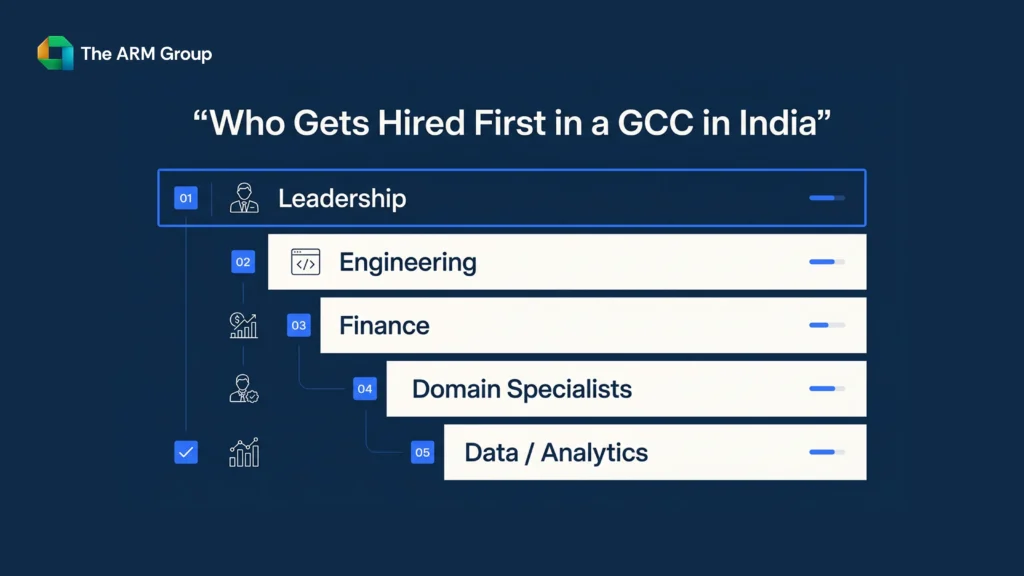
Leadership teams often picture the offshore center as a support function. The hiring data tells a different story.
Here’s what’s actually getting hired right now:
- Leadership and center heads who can run India operations with full P&L ownership, not just report status upward
- Engineering and product roles, from platform engineers to AI/ML specialists building on global codebases
- Finance, controllership and FP&A roles that own regional books, not just data entry
- Domain specialists in BFSI, pharma and manufacturing who understand the industry, not just the tech stack
- Data, analytics and automation talent supporting global decision-making, not local reporting
A GCC in India today competes for the same senior talent that IT services companies and product startups are chasing. Treating it like a standard offshore hiring exercise is exactly why so many first-time centers stall out in the first six months.
The Best Talent Markets in the Country
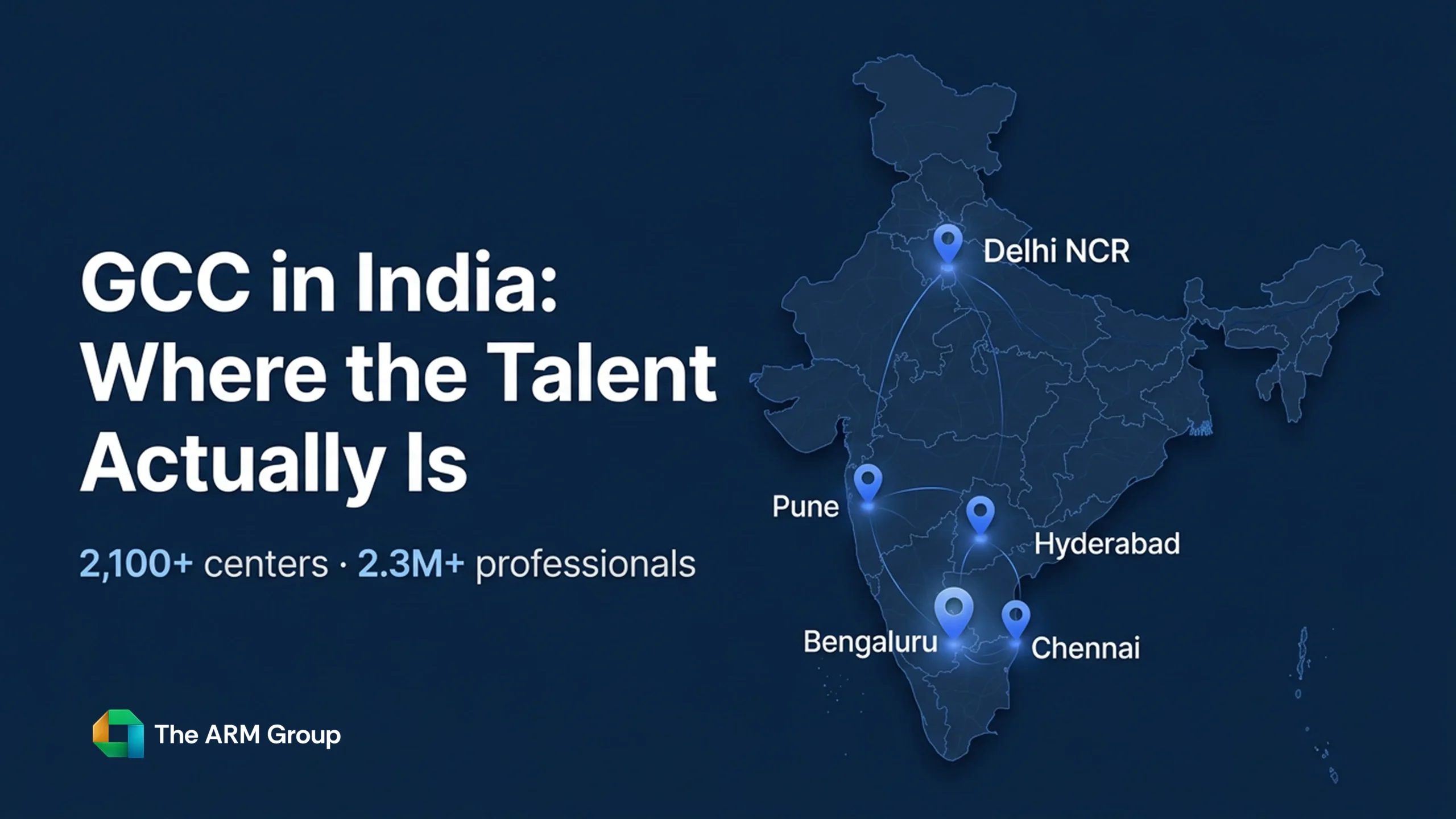
Not every city gives you the same GCC in India. The talent map matters as much as the org chart.
- Bengaluru remains the largest hub, home to nearly a third of all GCC units and a similar share of installed talent
- Hyderabad has become the go-to city for BFSI-focused centers, pulling in a large share of new banking and financial services entrants
- Pune works well for engineering-heavy and manufacturing-linked centers
- Chennai offers strength in core engineering and increasingly, finance functions
- Delhi NCR (Noida, Gurgaon) suits centers that need proximity to sales, marketing and business leadership talent
Picking a city without checking which specific roles that city actually produces at scale is one of the most common, and most expensive, first mistakes.
Why Hiring for a GCC Takes Longer Than Leadership Expects
Here’s the part nobody puts in the board deck.
A generic job posting gets flooded with applicants who’ve never worked in a captive setup. They don’t know the difference between reporting to a vendor client and reporting to their own parent company. That gap shows up in month two, not the interview.
The real bottleneck isn’t candidate volume. It’s finding people who already understand how a GCC in India actually operates: the dual accountability, the global stakeholder calls at odd hours, the expectation to own outcomes rather than tickets. Screening for that takes longer than screening for a skill match on a resume.
Companies that don’t budget for this timeline end up making rushed senior hires. Those hires rarely last past the first reorg.
Build It Yourself or Partner: How Smart Companies Staff Up
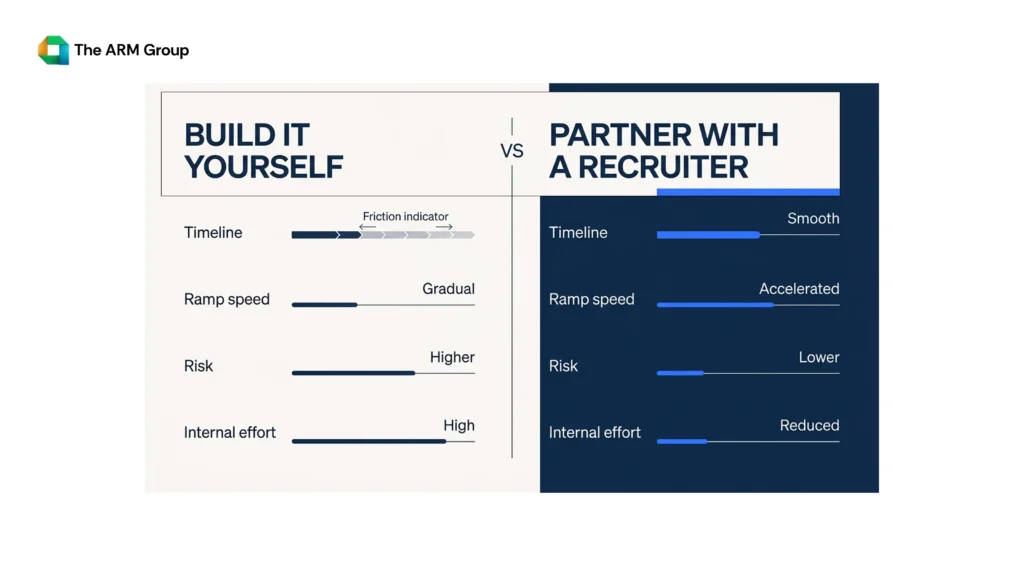
There are really only two paths here.
Build it yourself. Set up an in-house HR and TA function, learn the local hiring market the hard way, and accept a slower ramp-up while your team figures out which city, which salary bands, and which candidate pool actually work for you.
Partner with recruiters who already know the terrain. Skip the learning curve. Get a shortlist of people who’ve already worked inside a similar center, in the city that actually has that talent, at the seniority level you need.
Most first-time companies quietly wonder what is GCC in India hiring really going to take before they commit to anything. Then they end up partnering anyway, just six months later than they needed to.
How The ARM Group Actually Staffs Yours
The ARM Group runs full-cycle hiring for companies setting up or scaling a GCC in India, from the first center head down to individual contributor roles. That’s not a slogan, it’s the day-to-day work: sourcing, screening, and delivering shortlists inside a 24 to 48 hour window, so a client doesn’t lose momentum between board approval and the first offer letter.
For leadership and center head searches, the ARM Elite team runs the search, curating candidates who’ve specifically run captive operations before, not just senior professionals in adjacent roles. For the engineering, product and platform hiring that makes up the bulk of most centers, the IT & Technology Hiring Solutions team sources against the specific stack a client is building on. When a mandate includes BFSI or financial services work, the Financial Services & Consulting Hiring Solutions team handles domain-specific screening that a generalist recruiter would miss entirely, and the dedicated Banking Captives (GCCs & GICs) Hiring Solutions team takes over when the mandate is a banking or GIC captive specifically.
Ramp-up doesn’t happen in a straight line either. A center might need 8 hires in month one and 40 by month four. That’s where ARM Flexi comes in, scaling recruiting support up or down without a client having to rebuild their hiring process each time headcount targets shift. And for the mid-to-senior functional roles that sit between leadership and individual contributors, ARM Professional manages intake through offer, so nothing stalls waiting on a single point of contact. This is also the same team, profiled on the ARM Group’s own page, that has run these searches across 27+ countries, so a first-time client isn’t the first captive center they’ve ever staffed.
Frequently Asked Questions
What is GCC in India in simple terms?
It’s a company’s own offshore center, not an outsourcing vendor. It runs core functions like engineering, finance or analytics directly under the parent company’s brand and reporting structure.
How long does it take to hire the first 20 people?
With a specialist recruiting partner, most companies see a first shortlist within 48 hours and a full first cohort hired in 6 to 10 weeks, depending on seniority and city.
Which city is best for setting up a center?
It depends on function. Bengaluru leads for engineering scale, Hyderabad for BFSI, Pune and Chennai for manufacturing-linked and core engineering roles.
Is hiring for a GCC different from regular India hiring?
Yes. Candidates need captive-model experience, comfort with global stakeholder calls, and ownership mindset, not just skill-matched resumes.
Do I need a local HR team from day one?
Not immediately. Many companies partner with a recruiting firm for the first 12 to 18 months, then build in-house HR once headcount and processes are stable.
What roles get hired first?
Typically a center head or leadership hire comes first, followed by core engineering, finance and domain specialist roles as the mandate expands.
Conclusion
A GCC in India is only as strong as the first eighteen months of hiring behind it. Get the roles, the city, and the timeline right early, and the center builds momentum on its own. Get it wrong, and you’ll spend year two fixing what year one rushed through.
Key Takeaways
- A GCC in India is a company’s own offshore unit, not a vendor, which changes how you should hire for it
- The country hosts over 2,100 such centers employing more than 2.3 million professionals as of FY2026
- Roles inside these centers now span leadership, engineering, finance and domain specialists, not just support functions
- City choice should follow function: Bengaluru for scale, Hyderabad for BFSI, Pune and Chennai for engineering
- Candidates need captive-model experience, not just a matching skillset on paper
- Rushed senior hires rarely survive the first reorg
- Most companies that try to build hiring in-house end up partnering later anyway
- A specialist recruiting partner can deliver shortlists within 24 to 48 hours
- Getting the first 18 months of hiring right sets the trajectory for the entire center
Ready to Build Your Team?
If you’re setting up or scaling a GCC in India, talk to a real recruiter before you write the next job description. Get in touch with The ARM Group today.

Sam B
Sam B is an executive search and senior-hiring specialist at The ARM Group, partnering with talent acquisition leaders to build high-performing teams through strategic mid- and senior-level placements across India and worldwide. With more than 15 years of experience, Sam excels at understanding organizational needs, identifying impactful talent, and navigating the complexities of executive and senior-level search. Skilled in strategic hiring, talent scouting, and building diverse, inclusive leadership teams, Sam brings both market insight and a consultative approach to every mandate — helping visionary leaders attract the talent that powers mission-critical roles.