
You’ve made a direct hire before. It looked perfect on paper. Three months in, it wasn’t working, and now you’re back to square one, minus the time, minus the budget, minus your team’s patience. This is exactly the scenario temp to hire staffing exists to prevent.
So here’s the real question. Is direct hire actually the safer bet, or does temp to hire staffing quietly do a better job of protecting you from that exact scenario?
Table of Contents
- The Basics of This Hiring Model
- The Core Difference Between the Two
- Where This Model Actually Reduces Risk
- Where Direct Hire Still Wins
- The Real Cost Comparison
- How to Decide Which Model Fits Your Next Hire
- How The ARM Group Runs Both Models
- Frequently Asked Questions
- Key Takeaways
What Is Temp to Hire Staffing, Really?
Temp to hire staffing starts a candidate on a trial period, usually 60 to 90 days, working full time on your floor or in your systems, before either side commits to anything permanent.
You’re not signing up for a probation clause buried in an offer letter. You’re watching someone actually do the job, in real conditions, before you decide anything.
Direct hire skips that step. You interview, you extend an offer, and the person is your full-time employee from day one. No trial run. No second look before the commitment.
Neither model is automatically better. What matters is which one matches the risk you’re actually trying to avoid.
Temp to Hire vs Direct Hire: The Core Difference

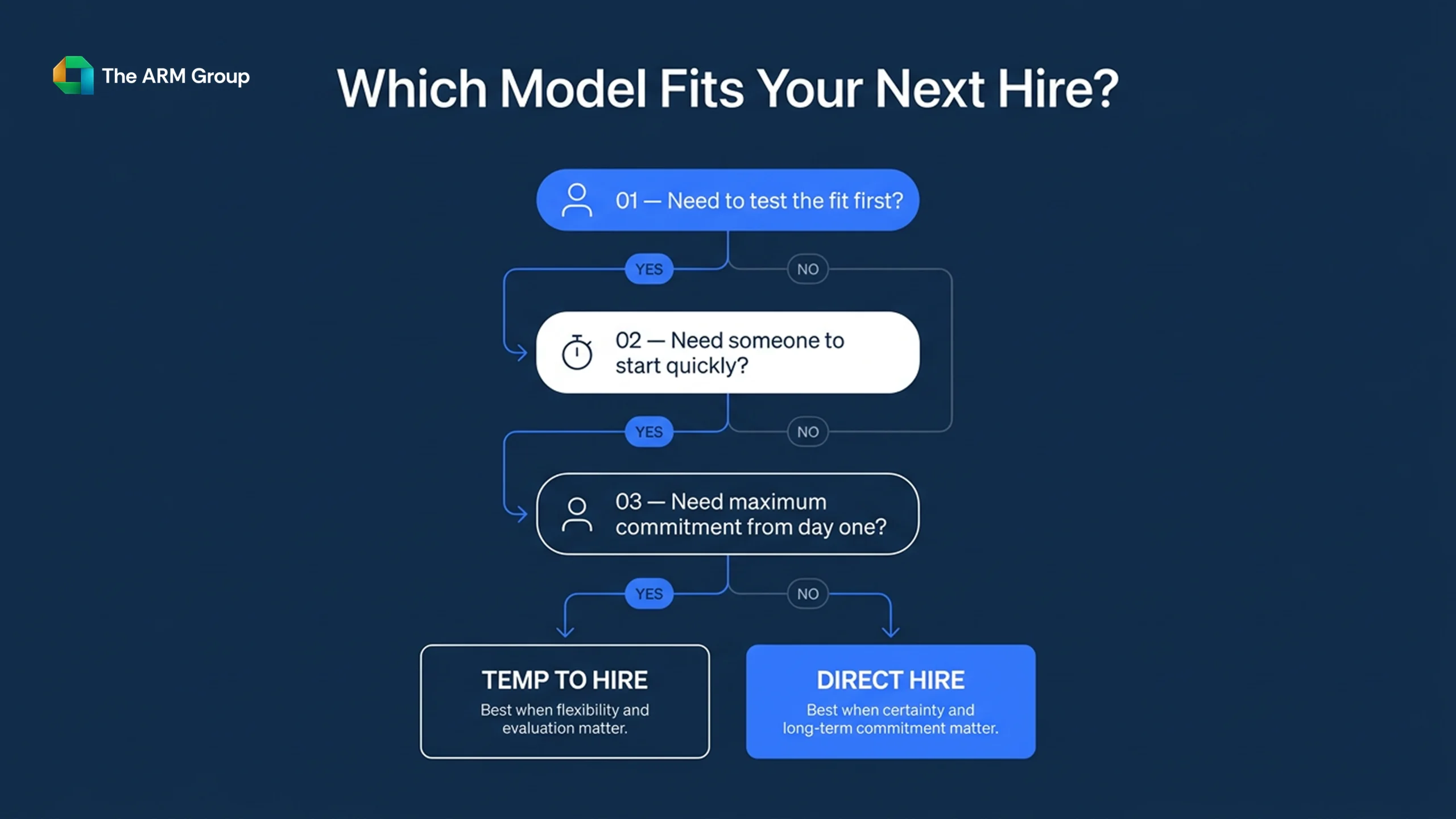
Here’s the one-line version. Temp to hire lets you test before you commit. Direct hire asks you to commit before you test.
That difference shows up everywhere once you look for it.
- Who carries the risk during evaluation: with temp to hire staffing, the staffing partner carries the employment risk while you evaluate. With direct hire, you carry it from day one.
- Speed of exit if it’s not working: ending this arrangement is a conversation with your staffing partner. Ending a direct hire is a termination process, with all the paperwork and exposure that comes with it.
- Speed of start: direct hire usually wins here. There’s no trial period to wait through before someone is fully yours.
- Candidate pool: some senior, in-demand candidates won’t consider this route at all. They want the offer, not the audition.
Where Temp to Hire Staffing Actually Reduces Risk
The risk that temp to hire staffing protects against isn’t skill mismatch. Most resumes get that part right. It’s fit mismatch, the stuff that never shows up in an interview.
Does this person actually show up on time, every time? Do they work well with the team lead they’ll report to? Can they handle the pace on a real production floor, not just describe it well in a screening call?
You cannot interview your way to those answers. You can only observe them.
That’s exactly why manufacturing floors, warehouses, and seasonal-heavy operations lean on this model so heavily. A single bad direct hire on a production line doesn’t just cost a salary, it can slow down the whole line while you scramble to backfill.
Where Direct Hire Still Wins
Temp to hire isn’t the answer for everything, and pretending otherwise does a disservice to companies reading this for a real decision.
Senior and leadership roles rarely work this way. Nobody wants to run a company’s finance function or lead a product team on a 90 day trial basis, and the candidates who could do it well won’t accept those terms either.
Speed-critical roles also lean direct hire. If a role needs to be filled and producing value in two weeks, not two months, the trial period built into this model becomes a liability instead of a safeguard.
And for roles where culture fit is obvious fast (a technical skill test tells you almost everything you need to know), the extra evaluation window adds cost without adding much protection.
The Real Cost Comparison
Nobody puts this in a boardroom slide, but it’s the number that actually matters.
According to SHRM, the average cost per hire sits near $4,700, and many employers report the total cost of a bad hire runs three to four times a role’s annual salary once you count lost productivity, retraining, and the search to replace them. A $60,000 role gone wrong can quietly cost $180,000 or more.
Temp to hire staffing doesn’t eliminate that risk completely, but it catches most of it before it becomes a six figure mistake. If the fit isn’t right during the trial period, you walk away with no severance, no termination paperwork, and no gap in coverage while you search again.
The American Staffing Association reports that staffing companies place close to 2.2 million temporary and contract workers in an average week, and a large share of those roles exist specifically because employers want a trial period before making a permanent call. That’s not a niche workaround. It’s a mainstream hiring strategy.
How to Decide Which Model Fits Your Next Hire
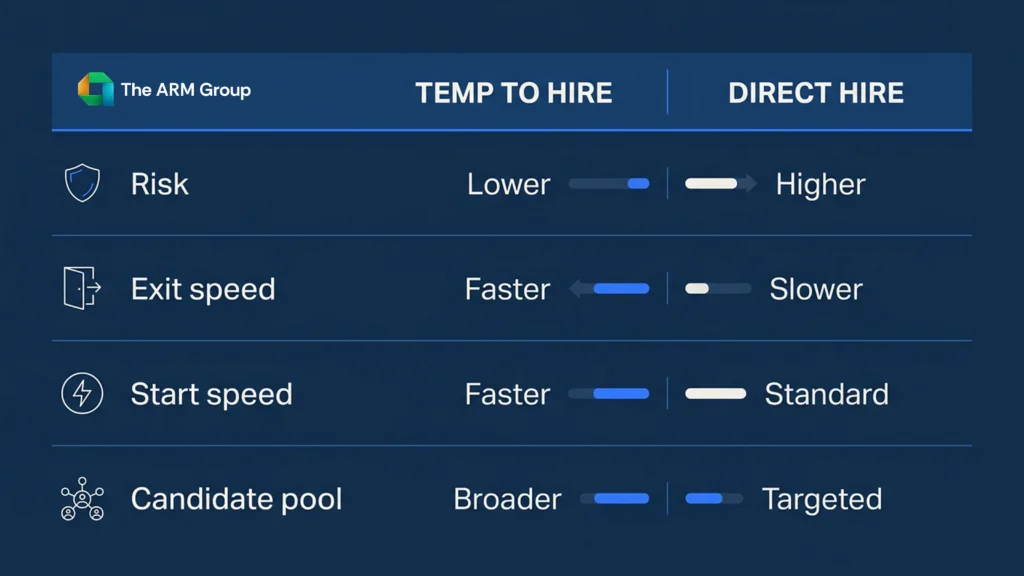
Ask yourself three questions before your next req goes out.
- Can a bad fit here actually hurt operations? If yes, especially in manufacturing, logistics, or any hands-on role, this model buys you protection.
- Is this a senior or leadership seat? If yes, direct hire is almost always the right call. It rarely attracts the caliber of candidate a senior role needs.
- How fast do you genuinely need this person fully committed? If the answer is immediately, direct hire wins on speed even if the trial model would reduce risk.
Most companies don’t pick one model for their entire hiring strategy. They run both, matched to the role, and that’s exactly how it should work.
How The ARM Group Runs Both Models
ARM Flexi is where temp to hire staffing actually happens day to day. It’s built for companies scaling volume roles up or down without a client having to rebuild their hiring process every time headcount shifts, whether that’s a seasonal ramp in a warehouse or a production line that needs 15 reliable hands next month. Candidates are screened for the fit questions an interview can’t answer, then placed on trial before anyone signs a permanent offer.
For roles where direct hire is clearly the right call, Hybrid Direct Placement combines targeted sourcing with rigorous screening so a client isn’t trading speed for risk. Senior and functional hires move through ARM Professional, while leadership and C-suite searches run through ARM Elite, curated shortlists included.
The split usually comes down to industry. Clients in manufacturing and logistics and transportation lean heavily on temp to hire staffing for floor and warehouse roles, while IT and technology clients often mix contract-to-hire for project roles with direct hire for core engineering seats. Nobody gets forced into one model because it’s simpler to sell.
Frequently Asked Questions
What is temp to hire staffing exactly?
It’s a hiring model where a candidate works full time on a trial basis, usually 60 to 90 days, before either side commits to a permanent role. It lets you evaluate fit before making it official.
Is temp to hire more expensive than direct hire?
Not usually. You avoid severance, unemployment claims, and a second full search if the trial doesn’t work out, which often makes it cheaper than a failed direct hire.
How long does the trial period last?
Most run 60 to 90 days, though it varies by role and industry. Manufacturing and warehouse roles often use shorter windows than professional or technical positions.
Can senior roles use a temp to hire model?
Rarely. Most senior candidates expect a direct offer, and the trial format doesn’t fit leadership accountability well.
Does temp to hire staffing slow down my hiring timeline?
Slightly, because of the trial period, but it’s often faster overall once you factor in the time a bad direct hire costs you in re-hiring and retraining.
Which industries use this hiring model the most?
Manufacturing, logistics, warehousing, and other operationally heavy sectors lean on it most, since fit issues on the floor are expensive and hard to catch in an interview.
Conclusion
Temp to hire staffing and direct hire aren’t competing philosophies. They’re two tools that solve different risks. Match the model to the role, not the other way around, and you’ll stop repeating the same expensive mistake every hiring season.
Key Takeaways
- Temp to hire staffing lets you evaluate a candidate on the job before committing, direct hire asks you to commit first
- The staffing partner carries employment risk during the trial, not the client
- Direct hire wins on speed and for senior or leadership roles that need full commitment from day one
- A bad direct hire can cost three to four times the role’s annual salary once lost productivity and re-hiring are counted
- Manufacturing, logistics, and warehouse operations lean on this model because fit issues are expensive and hard to interview for
- Nearly 2.2 million people work through staffing companies in the US in an average week
- Most companies run both models side by side, matched to the specific role, not one strategy for everything
- The three questions to ask before choosing: operational risk, seniority, and how fast you need full commitment
- Getting the model right the first time avoids repeating the same expensive hiring mistake next quarter
Ready to Match the Right Model to Your Next Hire?
Whether it’s temp to hire staffing for your next volume ramp or a direct hire for a role you can’t afford to get wrong, talk to a real recruiter first. Get in touch with The ARM Group today.

Bhargav C Rob
Bhargav C — who goes by “Rob” — serves as AVP of Global Recruitment Operations at The ARM Group, overseeing hiring across three continents and 50+ countries. Over 15+ years he has scaled teams, placed senior leaders, and built employer brands that attract high-caliber talent. He leads recruiters who go beyond filling roles to shaping the companies they hire for, bringing deep expertise in global talent acquisition, applicant tracking systems, and strategic sourcing. Whether he's between airports or on back-to-back Zoom calls, Rob thrives on the round-the-clock rhythm of global hiring.