


If hiring demand keeps changing, adding permanent recruiters may create excess capacity later, while relying on agencies role by role can fragment the process. Recruitment process outsourcing, or RPO, is an arrangement in which an employer gives an external provider defined responsibility for part or all of its recruitment operation. The provider works against agreed processes, service levels, data, systems, and outcomes, while the employer keeps authority over business needs and final hiring decisions.
RPO is most useful when the problem is bigger than one vacancy. It can support sustained hiring volume, a new location, a business transformation, specialist talent demand, or an internal recruitment team that needs scalable delivery capacity.
Key Takeaways
- RPO transfers defined recruitment-process responsibility, not the employer’s final accountability for hiring decisions.
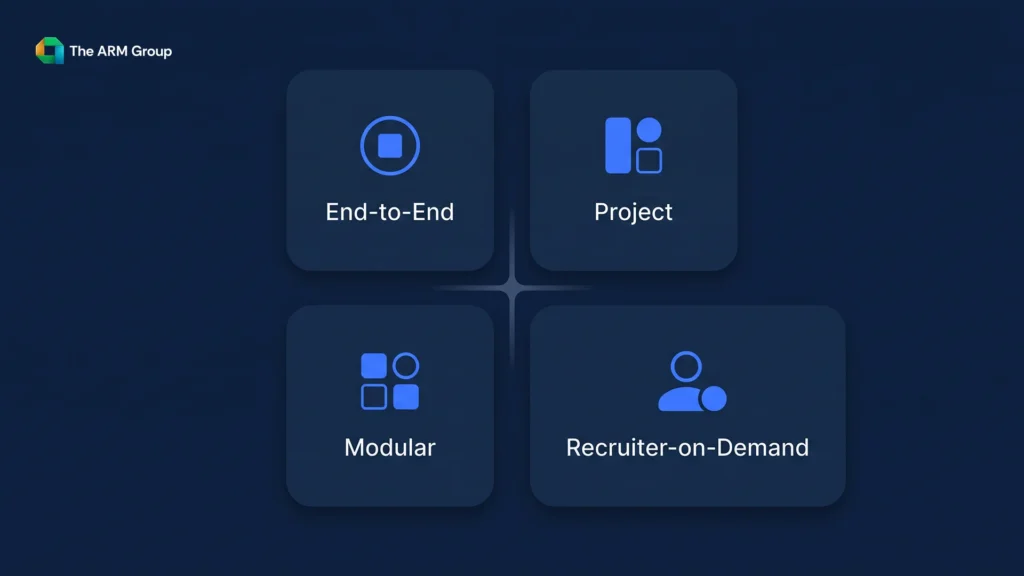
- End-to-end, project, modular, and recruiter-on-demand models solve different demand patterns.
- A company is usually RPO-ready when hiring demand is measurable, repeated, and large enough to justify shared processes and governance.
- The agreement should define scope, decision rights, systems, candidate ownership, service levels, reporting, data handling, and exit arrangements.
- RPO performance should be measured across speed, conversion, quality, experience, compliance, and business readiness, not only cost per hire.
How Does Recruitment Process Outsourcing Work?
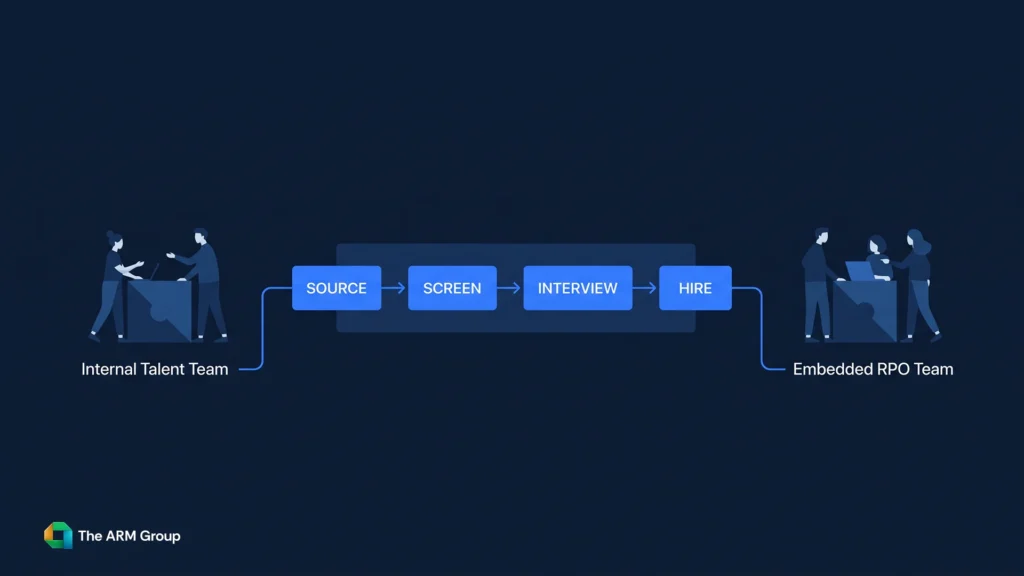
RPO works by assigning a provider an agreed recruitment scope and integrating that team into the employer’s hiring process. The Recruitment Process Outsourcing Association’s definition distinguishes RPO from transactional placement because the provider assumes responsibility for designing and managing defined parts of the process.
The employer and provider first establish demand, roles, locations, volumes, decision rights, technology, and performance measures. The provider may then manage requisition intake, sourcing, screening, interview coordination, offer administration, candidate communication, and reporting. The employer normally retains workforce approval, compensation authority, hiring-manager participation, and the final decision.
The operating model matters more than the label. An arrangement that supplies resumes without shared workflows, governance, or outcome measures is closer to agency recruitment than RPO.
What Can an RPO Provider Manage?
An RPO provider can manage the full recruitment cycle or a selected set of activities. The exact boundary should be written into the scope rather than assumed.
Typical activities include:
- Workforce-demand intake and requisition management.
- Role calibration and job-posting support.
- Recruitment marketing and sourcing.
- Applicant review and structured screening.
- Interview scheduling and feedback coordination.
- Offer administration and candidate communication.
- Preboarding and onboarding coordination.
- Recruitment technology, supplier, and reporting support.
Some employers retain interviews, selection, compensation, background-check decisions, or onboarding internally. Others use RPO for one business unit, location, or role family. The boundary should also state who owns candidate records, communications, approvals, and unresolved exceptions.
For skilled permanent roles, ARM Professional supports requirement definition, sourcing, screening, shortlist development, interview coordination, and joining support. An RPO scope can build those activities into a repeatable employer-wide process.
Which RPO Model Fits Each Hiring Need?
Choose the model by demand pattern, process scope, and duration. A large end-to-end program is unnecessary when the real need is temporary sourcing capacity for one project.
| RPO Model | Best Fit | Typical Scope | Main Buyer Risk |
| End-to-end RPO | Sustained hiring across roles or business units | Most stages from requisition through onboarding support | Transferring a weak process without redesigning it |
| Project RPO | Expansion, launch, relocation, or defined hiring campaign | Fixed roles, volume, locations, and period | An unclear finish line or handback plan |
| Modular RPO | A specific bottleneck such as sourcing or screening | One or more recruitment stages | Poor handoffs between provider and internal team |
| Recruiter on demand | Short-term capacity gap or demand surge | Embedded recruiters working within the employer’s process | Paying for activity without defined outputs |
For uncertain or seasonal worker demand rather than recruitment-process ownership, ARM Flexi may be a better fit. It supports temporary, contract, seasonal, and hybrid staffing requirements.
How Is RPO Different From Staffing and Recruitment Agencies?
RPO manages an agreed recruitment process, while an agency usually works on individual vacancies and staffing supplies workers under a defined employment arrangement. The models can coexist, but they solve different problems.
An agency is often suitable when an employer needs help with several specialist permanent roles. A staffing provider is useful for temporary, contract, shift-based, or project capacity. Executive search fits confidential and business-critical leadership hiring. RPO is the stronger fit when the employer wants repeatable delivery, embedded capacity, process ownership, governance, and consolidated reporting across a hiring program.
The ARM Group’s executive search service focuses on senior and confidential appointments. Its guide to executive recruitment models also explains how RPO differs from retained, contingent, and hybrid recruitment approaches.
When Should Companies Use RPO?
Companies should consider RPO when recruitment demand is repeated, measurable, and difficult to manage consistently with current capacity. The case becomes stronger when several of these conditions occur together:
- Approved hiring volume is expected across multiple months.
- A new facility, capability center, product, or geography needs a coordinated hiring ramp.
- Internal recruiters cannot absorb demand without delaying priority roles.
- Different departments or agencies use inconsistent screening and reporting.
- Specialist or passive-candidate sourcing is required across many roles.
- Leaders lack a reliable view of requisitions, pipeline conversion, offers, and joining risk.
- Fixed internal recruiting capacity does not match fluctuating demand.
The U.S. Bureau of Labor Statistics reported 7.3 million job openings and 5.1 million hires in July 2026. Those national figures do not determine whether an individual employer needs RPO, but they show why workforce demand and actual hiring flow must be measured separately.
For U.S.-India expansion, cross-border hiring support can help employers plan roles, locations, sourcing, screening, leadership needs, and joining considerations across the two markets.
When Is RPO the Wrong Choice?
RPO is usually the wrong choice when hiring is rare, undefined, or blocked by decisions the provider cannot control. A business with one occasional specialist vacancy may get more value from a targeted recruiter. A company whose headcount, compensation, or job requirements change weekly should fix governance before transferring the process.
RPO will not repair slow manager feedback, unrealistic pay, repeated approval reversals, or an unattractive role unless the employer agrees to change those conditions. It also should not be used to distance leaders from final hiring accountability.
Before buying RPO, confirm that you can forecast demand, name decision owners, provide system access, define essential criteria, respond within agreed times, and share lawful candidate data. If those foundations are missing, start with a recruitment-process review or a smaller project scope.
How Do You Implement RPO Without Losing Control?
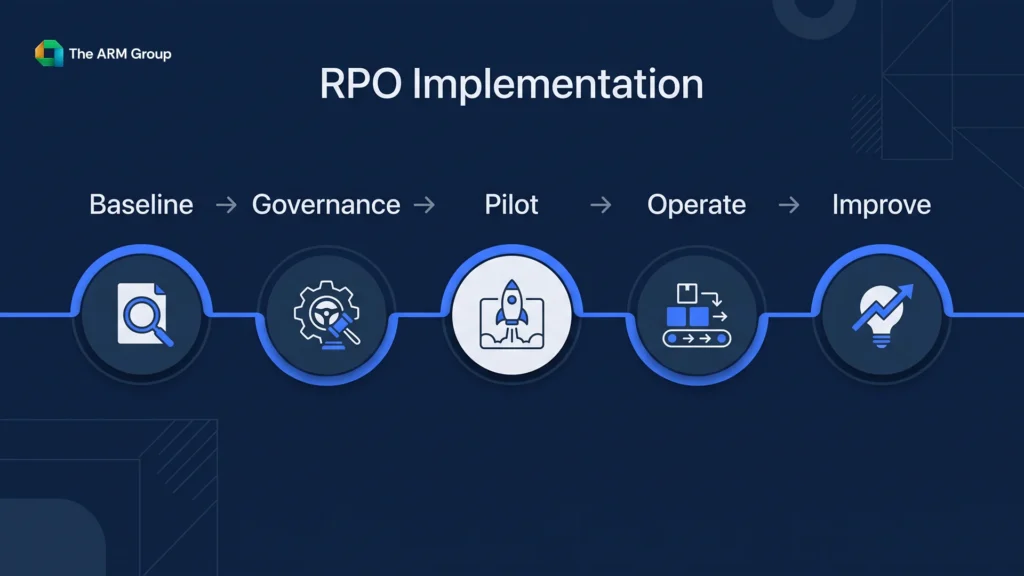
Implement RPO in phases, with explicit decision rights and a controlled handover. The provider needs enough authority to run the process, while the employer needs visibility into decisions, data, risk, and candidate experience.
Phase 1: Baseline and Scope
Map current demand, workflow, systems, suppliers, costs, conversion, delays, and compliance controls. Define which roles, locations, business units, and stages are included.
Phase 2: Design and Governance
Document the future process, ownership matrix, service levels, escalation path, reporting definitions, candidate ownership, data handling, and approval gates. The U.S. Equal Employment Opportunity Commission advises employers to apply consistent standards and avoid decisions based on protected characteristics in recruitment, hiring, and promotion.
Phase 3: Transition and Pilot
Transfer active requisitions carefully, train stakeholders, test integrations, and run a limited role or business-unit pilot. Compare outputs with the baseline before expanding.
Phase 4: Operate and Improve
Hold weekly operational reviews during the ramp, then move to an agreed cadence. Review bottlenecks, exceptions, candidate feedback, hiring-manager response, and demand changes.
Which RPO Metrics and Service Levels Matter?
Use a balanced scorecard because one metric can hide failure elsewhere. Faster screening is not useful if interview conversion collapses, and lower cost per hire is not useful if joining failures rise.
| Dimension | Example Measures | Useful Service-Level Question |
| Demand readiness | Approved requisitions, forecast accuracy, intake completion | How quickly is an approved role released to market? |
| Speed | Time in stage, shortlist time, vacancy age | Where does the clock pause for employer action? |
| Conversion | Source-to-screen, interview-to-offer, offer-to-join | Which role, source, or manager creates the largest drop? |
| Quality | Hiring-manager acceptance, early performance evidence, new-hire retention | How and when will quality be assessed? |
| Experience | Candidate response, withdrawal reasons, feedback timeliness | What communication standard applies at each stage? |
| Governance | Exceptions, audit completion, data accuracy, escalation closure | Who owns each exception and by when? |
For U.S. employees, Form I-9 responsibilities should be clearly assigned. The U.S. Citizenship and Immigration Services states that employers must complete and retain Form I-9 for covered hires. An RPO contract should not leave statutory responsibilities implied.
What RPO Failure Modes Should Buyers Prevent?
The most damaging failure is transferring recruitment activity without fixing decision ownership. The provider then produces candidates, but requisitions, interviews, feedback, and offers still stall inside the employer.
Prevent these problems before launch:
- Undefined scope. Teams disagree about included roles, locations, and stages.
- Conflicting metrics. The employer and provider calculate time, cost, or quality differently.
- Weak hiring-manager commitments. Feedback and interview capacity are absent from service levels.
- Technology-first design. Tools are selected before the workflow and data ownership are clear.
- Candidate handoff gaps. Applicants receive inconsistent messages when responsibility changes.
- No exit plan. Data, open requisitions, supplier relationships, and candidate ownership become disputed at contract end.
Talk to The ARM Group about whether targeted recruitment, flexible staffing, executive search, cross-border hiring, or a broader outsourced recruitment model fits your hiring demand.
FAQs
What Does RPO Stand for in Recruitment?
RPO stands for recruitment process outsourcing. It describes an arrangement in which an external provider manages defined parts or all of an employer’s recruitment process.
What Is Recruitment Process Outsourcing in Simple Terms?
Recruitment process outsourcing means bringing in an external team to run an agreed hiring process rather than only fill individual vacancies. The scope may cover sourcing through onboarding coordination or selected stages.
What Is Included in RPO Recruitment?
RPO may include requisition intake, job advertising, sourcing, screening, interview coordination, offer administration, candidate communication, technology, reporting, and onboarding support. The contract should state the exact inclusions and exclusions.
What Is the Difference Between RPO and a Recruitment Agency?
An RPO provider manages a defined process and operating model, while an agency usually works vacancy by vacancy. RPO commonly includes governance, systems integration, service levels, and consolidated reporting.
What Is the Difference Between RPO and Staffing?
RPO manages recruitment activity, while staffing commonly provides temporary or contract workers under an agreed workforce arrangement. Employers may use both when permanent and flexible needs exist together.
How Much Does RPO Cost?
RPO pricing depends on scope, hiring volume, duration, geography, technology, and the allocation of recruiters and services. Common structures may include management fees, per-hire charges, resource-based fees, project pricing, or blended models.
How Long Does RPO Implementation Take?
Implementation time depends on program size, data quality, systems, integrations, stakeholder availability, active requisitions, and process redesign. A limited project or modular program can usually be prepared faster than an enterprise-wide transition.
Can Small and Mid-Sized Companies Use RPO?
Yes, if their hiring need is repeated or project-based and large enough to benefit from a managed process. A modular or project RPO can be more suitable than a full end-to-end program.
Does an RPO Provider Make the Final Hiring Decision?
The employer normally retains the final hiring decision, even when the provider manages most recruitment stages. Decision rights and accountability should be explicit in the operating model.
Conclusion
Start by defining the hiring problem. If you need help with isolated roles, targeted recruitment may be enough. If you need temporary capacity, staffing may fit better. When repeated hiring demand requires shared processes, scalable delivery, governance, and reporting, RPO becomes a credible option. Map the current process, choose the smallest suitable model, assign decision rights, pilot it, and expand only after the measures hold up.