

Everyone asks how long does recruitment process take. Almost nobody asks until the seat is already empty.
Here is the short answer: most roles take 4 to 8 weeks to reach an accepted offer, and executive searches often run longer. SHRM’s 2026 benchmarking puts the median at 39 days for nonexecutive roles and 45 for executive roles. Your recruitment timeline decides whether that feels like a plan or a fire drill.
TL;DR
- How long does recruitment process take? Plan for 4 to 8 weeks from opening the role to an accepted offer.
- SHRM’s 2026 medians are 39 days for nonexecutive roles and 45 days for executive roles.
- The slowest stages are sourcing, interview scheduling, and notice periods, not the offer itself.
- Fast feedback and a clear brief can save one to two weeks on almost any search.
- Technical, manufacturing, and leadership roles run longer than general office roles.
What’s in This Guide
- How Long Does the Recruitment Process Take on Average?
- What Does a Recruitment Timeline Look Like Stage by Stage?
- Why Do Some Roles Take Twice as Long to Fill?
- Where Do Hiring Delays Actually Come From?
- How Can You Shorten the Recruitment Timeline Without Rushing the Hire?
- Why Does the Wait After an Accepted Offer Add So Many Weeks?
- How The ARM Group Delivers Faster Hiring Timelines
- Frequently Asked Questions
- Key Takeaways
How Long Does the Recruitment Process Take on Average?
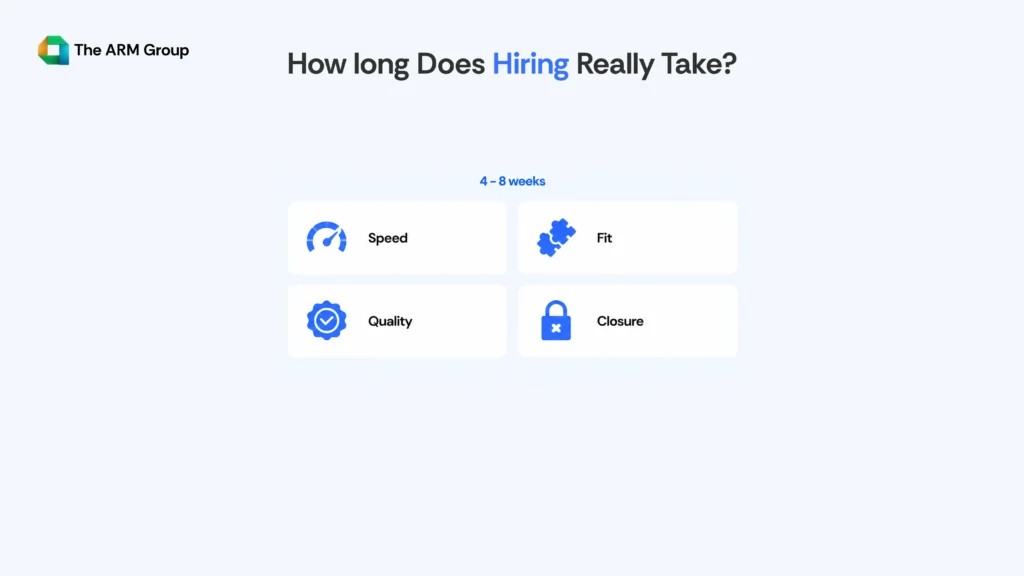
The honest answer to how long does recruitment process take is that it depends on the role, but 4 to 8 weeks is a safe planning range. SHRM’s 2026 recruiting benchmarking data shows a median time-to-fill of 39 calendar days for nonexecutive positions, down from 44 in 2025. Executive roles held steady at 45 days. That is the market average, not a promise.
Three clocks run at once, and mixing them up causes most of the confusion:
- Time-to-fill: days from opening the requisition to the candidate accepting the offer.
- Time-to-hire: days from a candidate entering your pipeline to accepting the offer.
- Time-to-start: days from acceptance to the first day of work.
Your finance team cares about the first and the third. Your recruiter lives in the second. Ask which clock someone is quoting before you trust the number.
So when someone asks how long does the recruitment process take, a useful answer gives all three clocks. A hiring estimate that stops at the offer skips the longest wait of all.
What Does a Recruitment Timeline Look Like Stage by Stage?
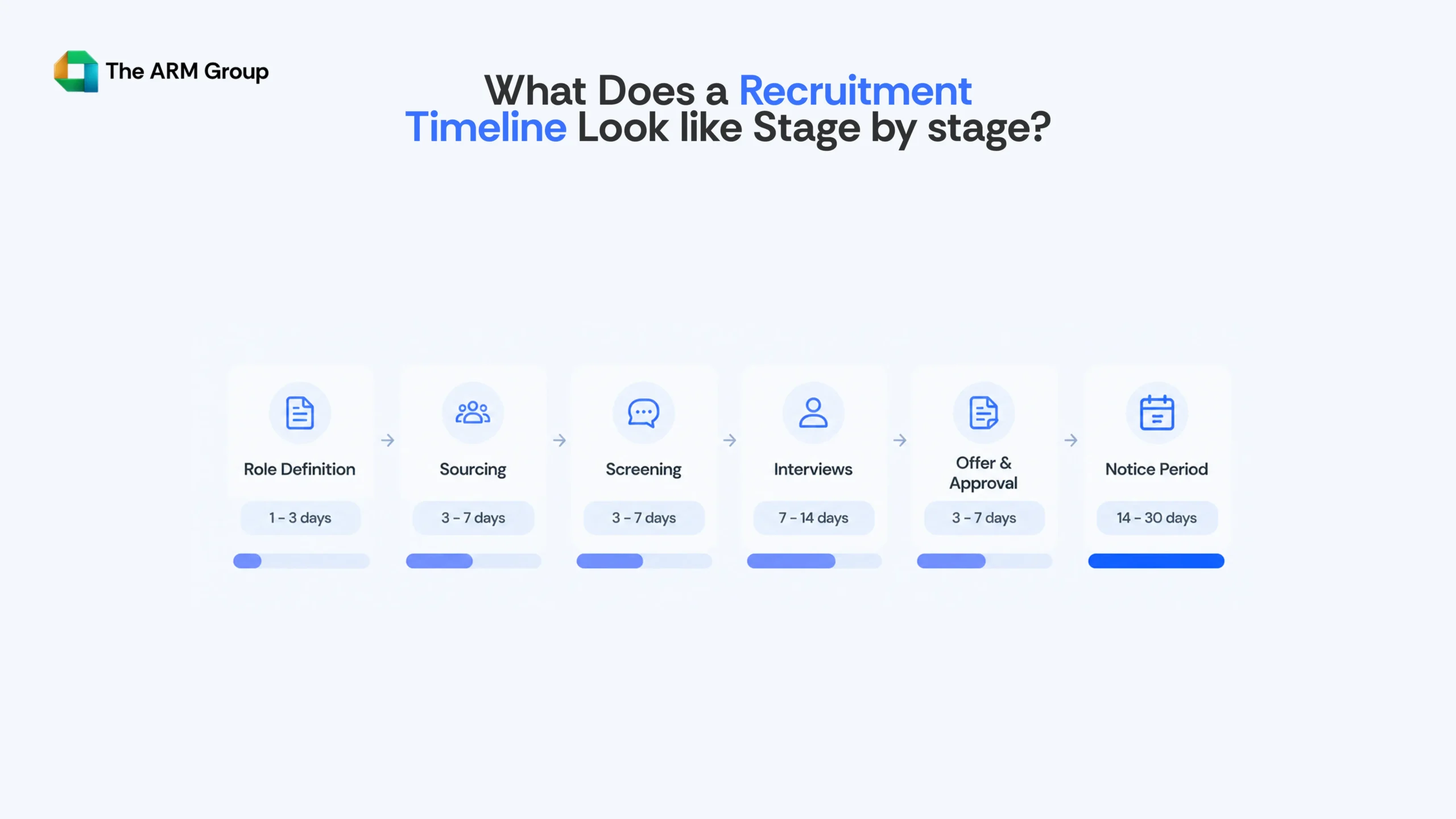
Wondering how long does the recruitment process take stage by stage? Every search follows the same six steps. The days below are typical planning ranges, not guarantees.
| Stage | What Happens | Typical Days |
| 1. Role scoping and approval | Brief, budget, and job description signed off | 3 to 7 |
| 2. Sourcing and outreach | Recruiters search, message, and qualify candidates | 7 to 14 |
| 3. Screening and shortlisting | Calls, skills checks, salary alignment | 5 to 10 |
| 4. Interviews | Scheduling, panel rounds, feedback | 7 to 14 |
| 5. Offer and negotiation | Offer, counteroffer, background checks | 3 to 7 |
| 6. Notice period and onboarding | Resignation notice, paperwork, start date | 14 to 60+ |
Add stages one to five and you reach an accepted offer in roughly 25 to 52 days. That is your 4 to 8 week range. Add stage six and your new hire may not sit at a desk for another two to eight weeks.
Here is the twist most hiring managers miss. Stages one and four are the ones you control. A recruiter can source all day, but a feedback email that sits for five days adds five days to the clock.
Why Do Some Roles Take Twice as Long to Fill?
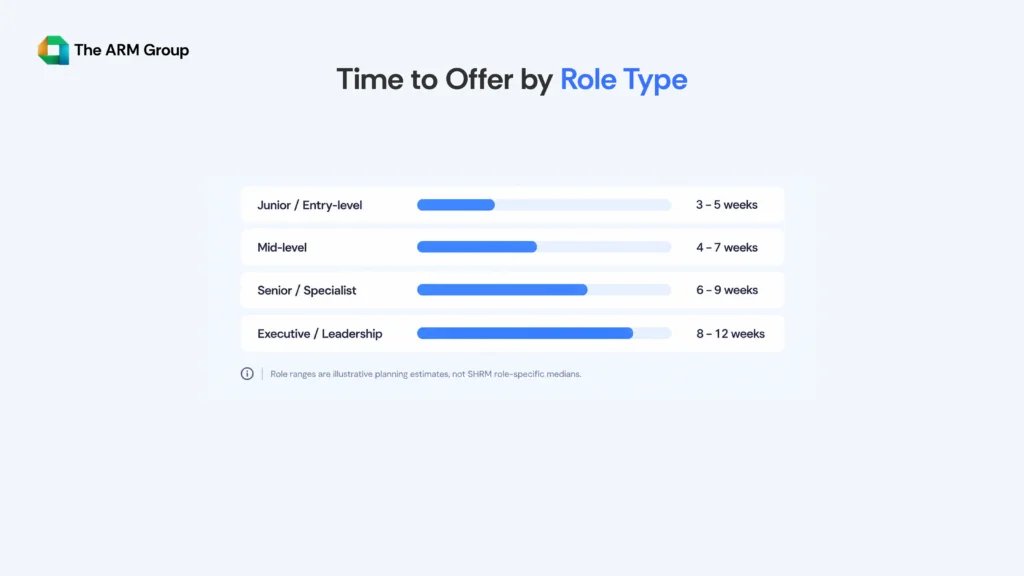
Candidate supply sets the pace, not effort. A role with thousands of qualified people moves fast. A role with a few hundred, all employed and fairly happy, moves slowly.
| Role Type | Typical Time to Accepted Offer | Why |
| Entry-level and volume | 2 to 4 weeks | Large pool, simple screening |
| Mid-level professional | 4 to 8 weeks | Passive candidates, several interview rounds |
| Technical (engineering, quality, maintenance) | 6 to 10 weeks | Small pool, skills checks, local competition |
| Executive | 45+ days (SHRM median), often longer | Confidential outreach, board input, long notice periods |
Picture a 200-person manufacturer in North Carolina hiring a quality engineer. The candidates exist, but most already have jobs, and they will not move for a vague posting. That is why manufacturing recruitment usually takes longer than general office hiring, and why a recruiter who knows the plant floor shortens the search.
Tech roles have the opposite problem. Candidates are plentiful, but the good ones collect multiple offers in a single week, so IT and technology hiring rewards speed over polish. Leadership searches sit at the far end. They are confidential and relationship-driven, which is where ARM Elite executive search excels.
So how long does the recruitment process take for your role? Find your row, then add notice.
Where Do Hiring Delays Actually Come From?
Rarely from recruiters. Usually from the gaps between the steps.
Meet the Silent Week. A candidate interviews on Tuesday. Feedback arrives the following Wednesday. By then the candidate has taken two other calls, and one of them came with an offer. Nobody did anything wrong. Everyone just waited.
The four most common causes:
- Vague briefs: requirements change after sourcing starts, so shortlists get rebuilt.
- Slow feedback: every silent day adds a day to the process and cools candidate interest.
- Too many rounds: five interviews rarely produce better decisions than three, only later ones.
- Late salary talks: pay mismatches surface at the offer stage, when they cost the most to fix.
A slow process does not feel slow from the inside. It feels busy.
How Can You Shorten the Recruitment Timeline Without Rushing the Hire?
Remove waiting, not thinking. Before any search starts, ask the question out loud: how long does the recruitment process take for this role, and who owns each stage?
Then work through this list:
- Lock the brief first. Agree on must-haves, salary band, and decision-makers on day one.
- Block interview slots early. Hold calendar space for the first two weeks of the search.
- Set a 24-hour feedback rule. Every interviewer replies within one business day.
- Cap rounds at three. Screen, functional or technical, final.
- Run checks in parallel. Start background checks and paperwork early. US employers must complete Form I-9 within three business days of the employee’s start date, per USCIS guidance.
Market context helps too. The Bureau of Labor Statistics tracks openings and hires monthly through its JOLTS survey, a useful read on how competitive your hiring market is right now.
Hiring in the Carolinas? A recruiting firm in Charlotte NC that knows local pay bands and commute expectations cuts the back-and-forth that eats days.
Why Does the Wait After an Accepted Offer Add So Many Weeks?
Because acceptance is not arrival. In the US, a two-week notice is common. In India, notice periods often run 30 to 90 days, which matters for any company moving talent across borders. Then come background checks, paperwork, and equipment.
Counteroffers are the final plot twist. A current employer matches the salary, and your candidate quietly stays. The fix is simple: ask about notice, counteroffer readiness, and start-date flexibility in the first screen, not on the offer call.
One early question can save the whole search.
How The ARM Group Delivers Faster Hiring Timelines
The slowest part of any search is the start, and that is where The ARM Group moves fastest. Our recruiters deliver pre-vetted shortlists in 24 to 48 hours, so sourcing and screening stop eating your first two weeks. Asking how long does recruitment process take is really asking where the waiting happens, and we aim at the first half of it.
Which service fits depends on the clock you are fighting. Hybrid Direct Placement pairs targeted sourcing with screening for time-sensitive direct hires, so a vacant plant supervisor or finance manager gets a shortlist, not a stack of résumés. ARM Professional covers mid-to-senior searches from intake to offer, including interview coordination and salary alignment, which is where most delays hide. ARM Flexi scales recruiting support up or down for volume and contract hiring, useful when a new site or product launch needs ten hires, not one.
The process stays simple: an intake call to lock the brief, a shortlist within 24 to 48 hours, interview coordination, and offer support. There is no commitment to start and no long-term lock-in. With India-based leadership and US execution, your search keeps moving across time zones, and your recruitment timeline gets shorter and more predictable.
Ready to see your own timeline? Click here to get a quote.
Hiring takes as long as your slowest decision, not your slowest recruiter. Once you know the stages, the delays, and the notice period waiting at the end, the question of how long does recruitment process take stops being a mystery. It becomes a number you can plan around, and often shorten.
Frequently Asked Questions
How long does the recruitment process take from start to finish?
Most roles take 4 to 8 weeks from opening the requisition to an accepted offer. Add 2 to 8 weeks for notice periods and onboarding before the first day. Technical and executive roles usually sit at the longer end of that range.
What is the average recruitment timeline for executive roles?
SHRM’s 2026 data puts the median time-to-fill for executive positions at 45 days. Full searches often run longer once confidential outreach, board interviews, and notice periods are included. Plan for two to four months from kickoff to start date.
What is the difference between time-to-fill and time-to-hire?
Time-to-fill counts from the day a requisition opens to offer acceptance. Time-to-hire counts from the day a candidate enters your pipeline to offer acceptance. Time-to-fill is always the longer number, and it is the one your business feels.
Why does recruitment take so long?
The main causes are small candidate pools, vague job briefs, slow interview feedback, and late salary conversations. Most lost days sit between steps, not inside them. Fixing feedback speed and the brief usually saves the most time.
How long does recruitment process take after an offer is accepted?
Expect two weeks in many US roles and 30 to 90 days in India, plus background checks and paperwork. Start those checks in parallel with the offer so the first day is not delayed by admin.
Can a recruitment agency make hiring faster?
Yes, mainly in sourcing and screening, the first two stages. An agency with an existing talent network can present a vetted shortlist in days instead of weeks. Interview speed and offer decisions still depend on your team.
Key Takeaways
- Most roles reach an accepted offer in 4 to 8 weeks, but the real wait often continues after acceptance.
- SHRM’s 2026 medians are 39 days for nonexecutive roles and 45 days for executive roles.
- Time-to-fill, time-to-hire, and time-to-start measure different things, so always ask which one someone is quoting.
- A clear recruitment timeline has six stages, and sourcing, interviews, and notice periods take the most days.
- Candidate supply, not recruiter effort, explains why technical and leadership roles take longer to fill.
- The Silent Week, meaning delayed interview feedback, is the most common and most fixable cause of lost candidates.
- Capping interviews at three rounds and replying within 24 hours can save one to two weeks.
- Ask about notice periods and counteroffers in the first screen to avoid surprises at the offer stage.
- Run background checks and paperwork in parallel, and complete Form I-9 within three business days of the start date.
- Asking how long does recruitment process take is smarter when you plan for all three clocks, not just the offer.
Need a hire made on a clock? Talk to a real recruiter.Call us on +1 803-830-7396 (US) or +91 96630-35271 (India).