
It’s Monday. Two of your best maintenance techs just resigned. A big order lands in six weeks. Finance says no new headcount.
So you open a job board. Close it. Open it again.
Here’s the plot twist: the job board isn’t the problem. The missing plan behind it is.
A staffing strategy is your plan for which roles you fill permanently, which on contract, and which flexibly, and when each hire happens. A clear staffing strategy turns hiring panic into a calm, repeatable staffing plan. Let’s build one.
TL;DR
- A staffing strategy matches every role to the right hiring model: permanent, contract, or flexible.
- A staffing plan is the dated, budgeted action list that puts the strategy to work.
- Permanent suits core roles, contract suits projects, flexible suits spikes.
- Decide before the vacancy appears, not after the resignation email.
What Is a Staffing Strategy, and Why Does It Matter?
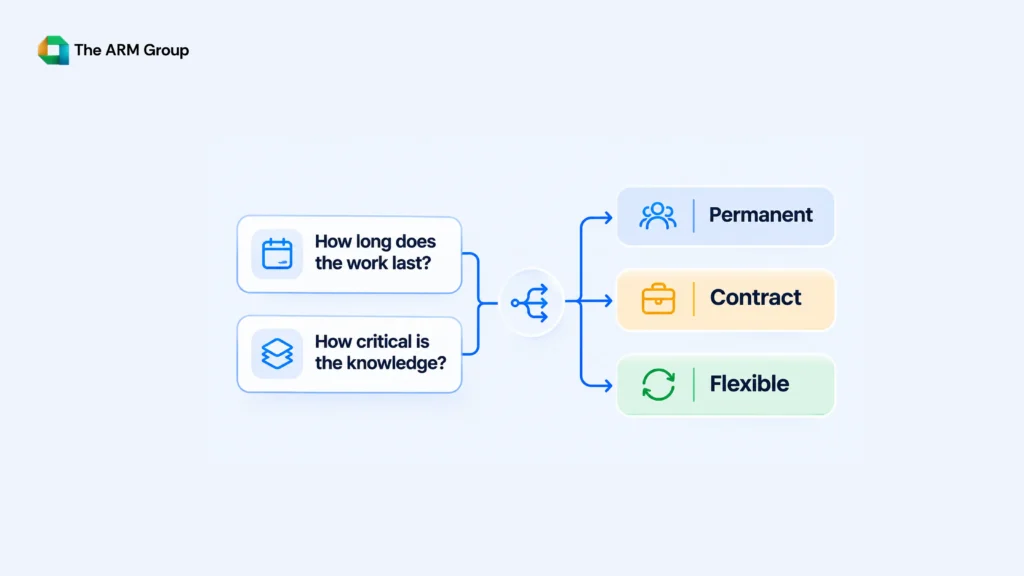
A staffing strategy is the big decision behind every hire: employee, contractor, or flexible worker? It answers three questions. What work do we have? How long will it last? Who should do it?
Without one, every vacancy becomes an emergency. Emergencies create rushed offers, shaky matches, and that special moment when a new hire leaves in week nine.
Think of it like a restaurant. The strategy is the menu. You don’t decide what to cook after the guests arrive.
And no, non-permanent work isn’t some fringe thing. The U.S. Bureau of Labor Statistics reported that 4.3 percent of workers, about 6.9 million people, held contingent jobs in July 2023. It’s a normal part of the mix.
How Is Strategy Different From a Plan?
Here’s the short answer: the strategy is the “what and why.” The plan is the “who and when.”
The strategy sets the rules. For example: “Quality leads are permanent. Holiday packing is flexible. One-off audits are contract.”
Your staffing plan applies those rules to a calendar. It lists roles, headcount, start dates, budget, and an owner for each hire.
Here’s a quick test. If you can’t put a date next to it, it’s still strategy. A real plan always has dates.
SHRM describes workforce planning as starting with business strategy and its implications for future talent needs. Same logic applies here. Business goals first, hiring second.
Permanent, Contract, or Flexible: Which Model Fits Which Role?
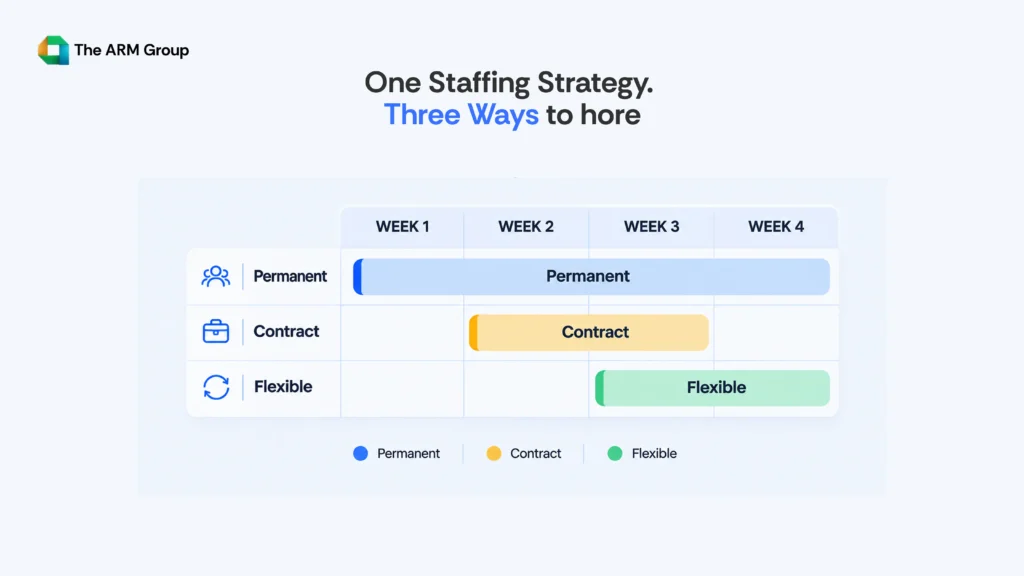
Ask two questions about every role. How long does the work last? How much does the knowledge matter?
| Hiring Model | Best For | Typical Length | Watch Out For |
| Permanent | Core roles: leadership, quality, engineering | Ongoing | Slow to fill, costly if mismatched |
| Contract | Projects, specialist skills, backfills | Weeks to months | Knowledge leaves with the contractor |
| Flexible | Seasonal peaks, volume hiring, ramp-ups | Days to weeks | Needs fast onboarding |
Long and critical? Go permanent. Short and specialist? Go contract. Spiky and repeatable? Go flexible.
Most companies need all three. A smart mix blends them, role by role.
How Do You Build a Staffing Strategy in Six Steps?
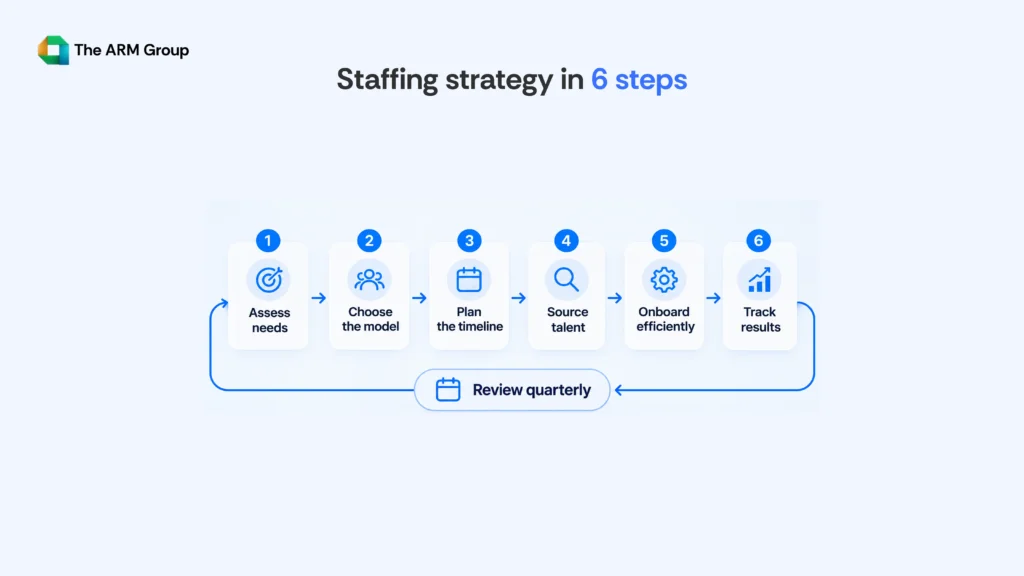
Honestly, it’s less scary than it sounds. Grab a coffee and a spreadsheet.
- List the work, not the job titles. Map what needs doing over the next 12 months.
- Sort each role by duration and risk. Use the table above.
- Spot the gaps. Compare who you have with who you’ll need.
- Pick a hiring model per role. Permanent, contract, or flexible.
- Turn it into a staffing plan. Add start dates, budgets, and owners.
- Review every quarter. Orders change, so your plan should too.
Picture a 200-person manufacturer in North Carolina (a hypothetical, but one you’ll recognise). Quality team: permanent. Line-expansion project: contract engineers. Holiday rush: flexible workers. Three needs, three models, zero panic.
What Mistakes Break the Strategy?
Three culprits show up again and again.
- The “Everything Is Urgent” mistake. Every role gets treated as a permanent, rush hire. Fix: sort roles first, then hurry only where it counts.
- The “Forever Contractor” mistake. A contractor sits in the same seat for years. Besides the continuity risk, there’s a legal one. The U.S. Department of Labor looks at the economic reality of a working relationship, not the label on the contract.
- The “Set and Forget” mistake. Your plan was last touched in January. Fix: put the review in the calendar now.
How Does the Strategy Work by Industry?
Same framework, different answers.
- Manufacturing: Permanent for quality and maintenance leads, flexible for production surges. See how manufacturing recruitment and workforce solutions fit this mix.
- IT: Contract for project builds, permanent for architecture and ownership. IT and technology hiring solutions cover both.
- Logistics: Flexible for peak season, permanent for operations managers. Logistics and transportation hiring solutions handle the swings.
A strategy that ignores your industry’s rhythm is just a nice document.
Why Is The ARM Group the Right Partner for Your Staffing Strategy?
Writing the strategy is step one. Filling the roles is where most plans stall. The ARM Group closes that gap with real recruiters, shortlists in 24 to 48 hours, and no commitment to start. That’s 85+ clients across 27+ countries who didn’t have to build it alone.
Each service maps to a hiring model. ARM Elite runs senior searches for C-suite, VP, and Director roles that anchor your permanent core. ARM Professional handles mid-to-senior permanent hiring from intake to offer. ARM Flexi scales contract, temp, and volume hiring up or down as your needs shift. When one role can’t wait, Hybrid Direct Placement combines targeted sourcing and screening to fill it faster.
Bring us your plan, even a rough one, and we’ll match each role to the right service. Indian companies hiring in the US get full-cycle recruiting without building a US HR team first.
Where Should You Start?
Start small. Pick the one role you keep re-hiring, choose its hiring model, and put a date next to it. Congratulations, that’s the first line of your plan. The rest is repetition.
Frequently Asked Questions
What is a staffing strategy?
It’s a plan that decides which roles you fill with permanent, contract, or flexible workers, and when. It links hiring to business goals, so vacancies stop feeling like emergencies.
What is the difference between a staffing strategy and a staffing plan?
The strategy sets the rules for hiring models. The plan applies those rules with dates, headcount, budgets, and owners. Strategy is the “why.” The plan is the “when.”
How do you create a staffing plan?
List your roles, assign each a hiring model, then add start dates, budgets, and owners. Review it every quarter, or whenever orders, projects, or key people change.
When should you use contract staff instead of permanent hires?
Use contract staff for projects, short-term backfills, or specialist skills you don’t need long term. Keep permanent hires for core roles where knowledge and continuity matter most.
How often should you review a staffing strategy?
Review the strategy once a year and the plan every quarter. Also revisit both after big changes like expansion, a new contract, or a leadership exit.
Key Takeaways
- Decide which roles are permanent, contract, or flexible before vacancies turn into emergencies.
- Add dates, budgets, and owners, so your strategy becomes real hiring action.
- Ask two questions per role: how long will the work last, and how critical is the knowledge?
- Permanent hiring suits core, long-term roles where continuity and company knowledge matter most.
- Contract hiring fits projects, backfills, and specialist skills with a clear end date.
- Flexible hiring absorbs seasonal peaks and volume surges without bloating your permanent headcount.
- Avoid the three big mistakes: treating everything as urgent, keeping forever contractors, and never revisiting the plan.
- Contractor classification depends on the real working relationship, not the label on the contract.
- Review your staffing strategy yearly and the plan quarterly to keep both current.
Conclusion
A strong staffing strategy helps you plan ahead instead of scrambling every time a vacancy opens up or demand changes. By matching permanent, contract, and flexible hiring to your business needs, you can control costs, fill skill gaps, and keep operations running smoothly. Start with the role you keep rehiring for, decide which hiring model makes the most sense, and build your staffing plan from there.
Ready to turn your staffing strategy into real hires? Click here to get a quote, or call us on +1 803-830-7396 (US) or +91 96630-35271 (India).
P.S. Which role do you keep re-hiring? That’s where we’d start.