

Last quarter you hired fast. Six weeks later, one new hire is lost, another is already job hunting, and your hiring manager is quietly wondering whether the interviews tested anything at all.
Speed was never the problem. If you want to know how to improve recruitment process results without lowering the bar, start here: tighten the brief, score every candidate the same way, reply within 24 hours, and track quality alongside speed.
TL;DR
- How to improve recruitment process results: fix the brief, use scorecards, set a 24-hour feedback rule, and measure quality of hire.
- Faster hiring comes from removing waiting between steps, not from skipping checks.
- Structured interviews predict job performance better than unstructured chats.
- Recruitment improvement starts with five simple metrics, not a new tool.
- SHRM’s 2026 medians of 39 days (nonexecutive) and 45 days (executive) give you a benchmark.
What’s in This Guide
- Why Does a Slow or Messy Recruitment Process Cost You Good Candidates?
- How to Improve Recruitment Process: Where Should You Start?
- How Do You Write a Brief That Attracts the Right People?
- How Can You Speed Up Hiring Without Lowering the Bar?
- Can AI Support Recruitment Improvement Without Hurting Quality?
- Which Recruitment Improvement Mistakes Hurt Candidate Quality Most?
- How The ARM Group Delivers Recruitment Improvement Without Cutting Corners
- Frequently Asked Questions
- Key Takeaways
Why Does a Slow or Messy Recruitment Process Cost You Good Candidates?
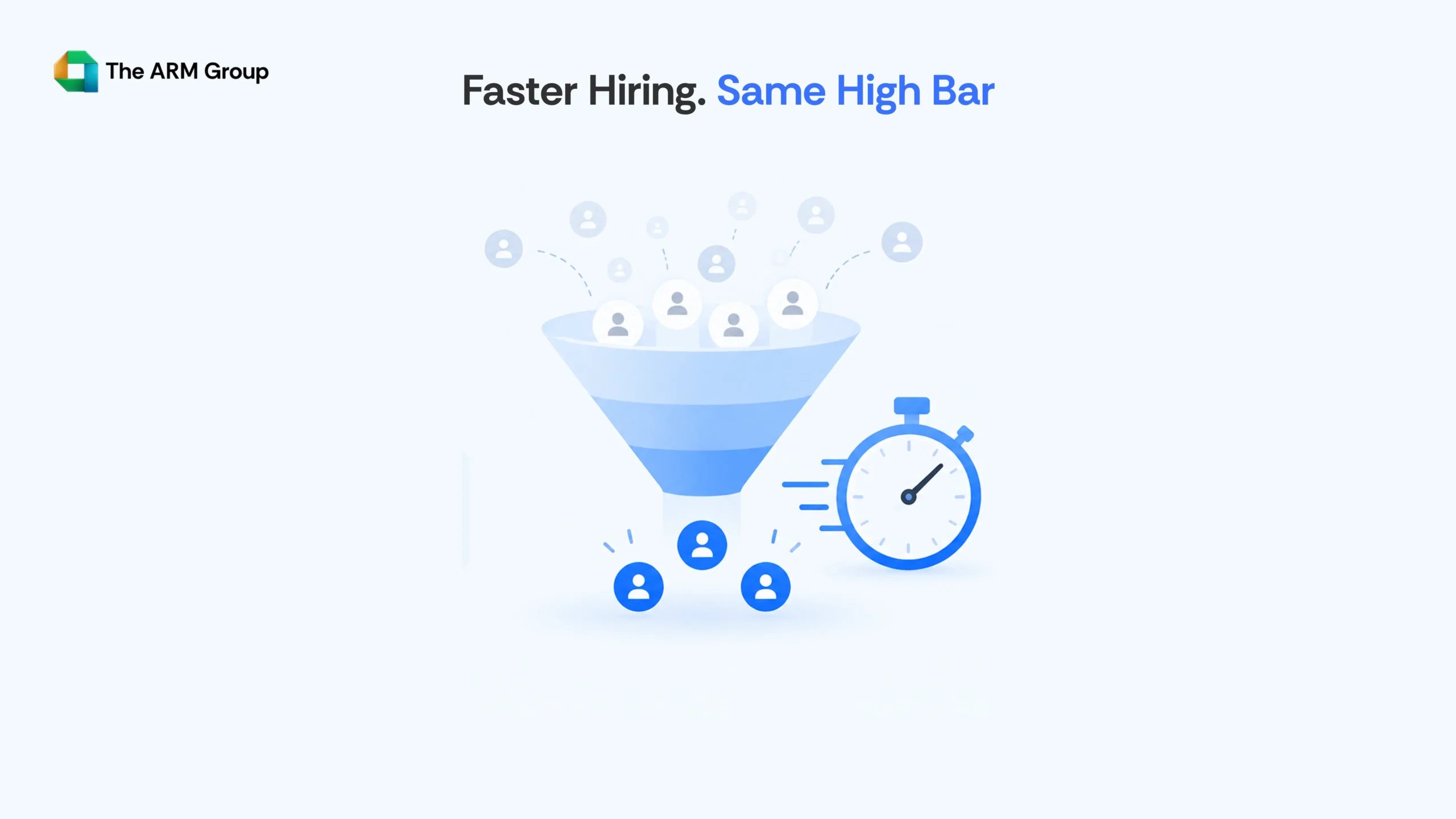
Because strong candidates do not wait. They are employed, curious, and usually talking to someone else too.
SHRM’s 2026 recruiting benchmarking puts the median time-to-fill at 39 days for nonexecutive roles and 45 days for executive roles. The Bureau of Labor Statistics adds market context through its monthly JOLTS survey on openings and hires. When openings run high, your best candidate has options, and the slowest process loses.
Here is the painful part. Most companies react by cutting steps. They skip reference checks, rush interviews, and hope for the best. That is the wrong cut. Knowing how to improve recruitment process results means cutting waiting, not rigor.
Speed and quality are not enemies. Silence is.
How to Improve Recruitment Process: Where Should You Start?
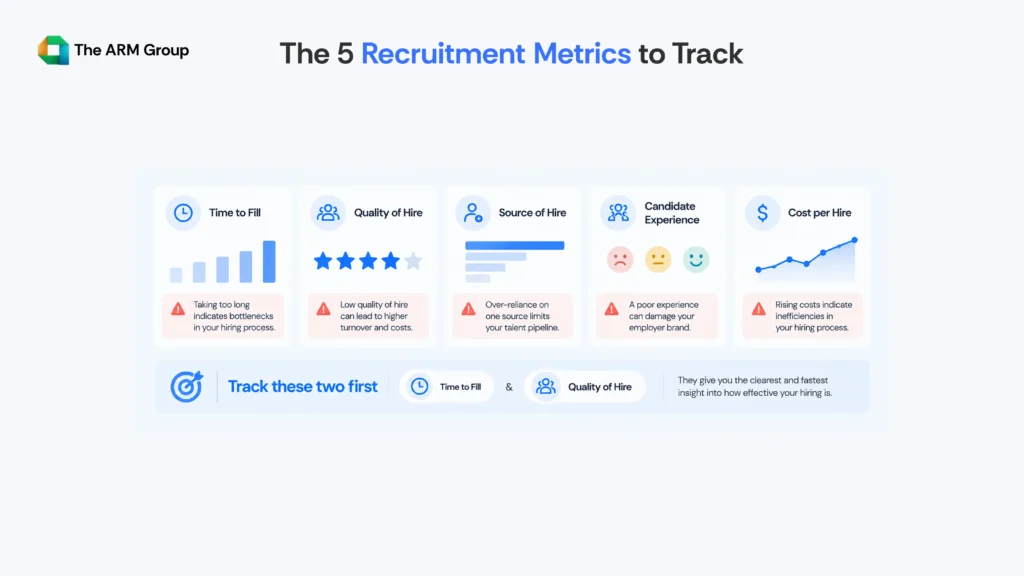
With measurement. You cannot fix what you have not counted.
| Metric | What It Tells You | Warning Sign |
| Time-to-fill | How long the whole search takes | Well above the SHRM medians |
| Stage drop-off | Where candidates leave | A big drop after the first interview |
| Offer acceptance rate | Whether your offers and process hold up | Frequent declines or counteroffers |
| Quality of hire | New hire performance at 6 to 12 months | Early exits or weak reviews |
| Candidate feedback | How the process feels from outside | No survey exists |
Pick two metrics to track this quarter. Recruitment improvement fails when teams try to fix everything at once.
Once you can see where candidates leave, how to improve recruitment process stages stops being guesswork. A drop after interview one points to a weak screen. A drop after the offer points to pay or timing. The numbers tell the story if you let them.
How Do You Write a Brief That Attracts the Right People?
Start by deleting half of it. The first step in how to improve recruitment process quality is a better brief, and most briefs are wishlists.
Meet the Wishlist Job Description: fourteen requirements, three of which actually matter. A manufacturer posting for a quality engineer with six certifications will filter out people who could do the job within a month. Split your list into three buckets instead:
- Must-have: skills the person needs on day one.
- Trainable: skills they can learn in 90 days.
- Bonus: nice to have, never a reason to reject.
Agree on the salary band before you post, not after the final interview. If you hire in North Carolina’s Triangle, a recruiting firm in Raleigh NC knows local pay ranges, so offers land right the first time. For technical roles, manufacturing recruitment specialists can help you tell a real requirement from a habit.
A long wishlist does not raise standards. It shrinks the pool.
How Can You Speed Up Hiring Without Lowering the Bar?
Make every interview comparable. The research is clear that structured interviews, where each candidate gets the same questions and the same scoring, predict job performance better than free-form chats. The OPM guide to structured interviews explains why.
Build a simple scorecard:
- Define 4 to 5 criteria tied directly to the job.
- Write the same questions for every candidate.
- Score each answer from 1 to 5 right after the interview.
- Compare scores first, then discuss impressions.
- Cap the process at three rounds: screen, functional, final.
Then meet the Gut-Feel Finalist. A charming candidate walks in, everyone loves them, and nobody checks whether they showed evidence of the skills the role needs. The scorecard asks one blunt question: what did they actually prove?
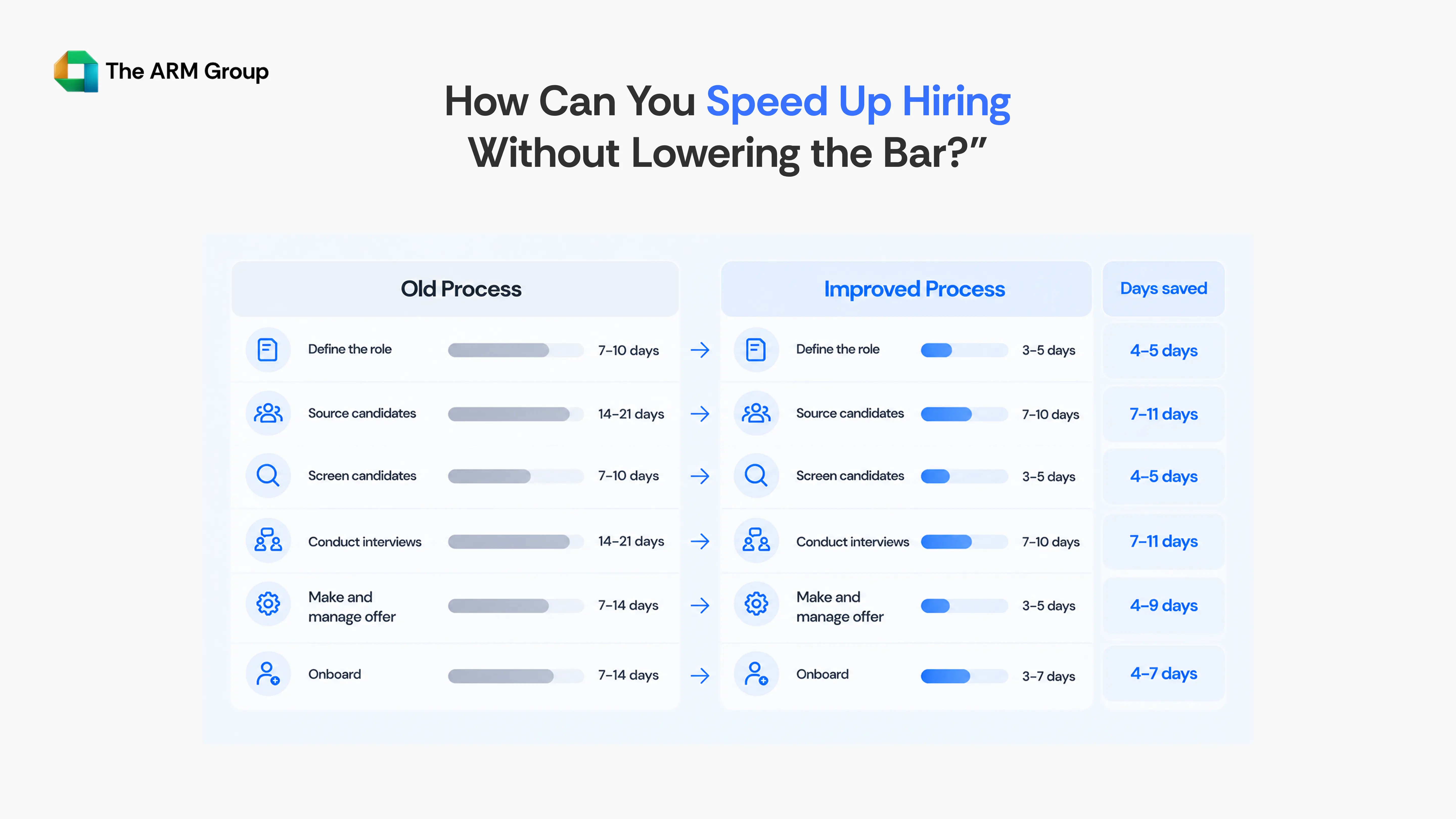
| Old Process | Improved Process |
| Open-ended chats | Same questions, scored 1 to 5 |
| Five or more rounds | Three rounds maximum |
| Feedback in a week | Feedback in 24 hours |
| Salary discussed at the end | Salary band agreed upfront |
| Success measured by time-to-fill | Success measured by time-to-fill and quality of hire |
That table is how to improve recruitment process speed without touching quality. For more tactics, see our guide to hiring strategies that work.
Can AI Support Recruitment Improvement Without Hurting Quality?
Yes, if AI handles the admin and humans handle the judgement. Use automation for interview scheduling, status updates, and first-pass résumé sorting. Keep people in charge of shortlists, interviews, and offers.
AI can book twelve interviews in a minute. It cannot tell you whether a candidate will thrive on your team. For a deeper look, read our breakdown of AI-based hiring.
Candidate experience belongs here too. Candidates who hear nothing for a week assume the answer is no. A simple automated acknowledgment within two days, plus a human update after each stage, protects your brand. When teams ask how to improve recruitment process speed with technology, the answer is simple: automate the waiting, not the deciding.
Which Recruitment Improvement Mistakes Hurt Candidate Quality Most?
The ones that look like progress.
- Changing everything at once. You cannot tell which change worked.
- Chasing time-to-fill alone. A fast, wrong hire is the most expensive hire.
- Skipping reference checks to save days. You saved two days and bought a six-month problem.
- Leaving the hiring manager out of intake. Misaligned expectations show up at the final round.
- Never reviewing the hire. Without a 90-day check, you never learn what your process predicts.
The 90-day review is the quiet engine of recruitment improvement. Compare the new hire’s performance with their interview scorecard. Where they disagree, your process has something to teach you. That loop is how to improve the quality of the recruitment process over time.
How The ARM Group Delivers Recruitment Improvement Without Cutting Corners
The fastest improvement in recruitment most teams can make lies in the first half of the process. If you are researching how to improve the stages of the recruitment process, sourcing and screening is where days quietly disappear. The ARM Group delivers pre-vetted shortlists within 24 to 48 hours, screened against your brief, so your team interviews fewer, better candidates.
ARM Professional runs mid-to-senior and functional searches from intake to offer: intake call, screening, interview coordination, and salary alignment. Hybrid Direct Placement fits time-sensitive direct hires, such as a vacant finance manager or plant supervisor, where you have a role, a deadline, and no time for a long sourcing round. ARM Flexi handles volume and contract hiring with the same screening standard, so ramping up ten hires does not mean lowering the bar for nine of them.
There is no commitment to start and no long-term lock-in. With India-based leadership and US execution, your searches keep moving across time zones.
Want a recruitment process that moves faster without cutting corners? Click here to get a quote.
Great hiring is rarely about one big fix. It is about removing small delays and small guesses until the process feels calm, fast, and fair. Once you know how to improve recruitment process results one stage at a time, quality stops being the price of speed. It becomes the reason for it.
Frequently Asked Questions
What is the fastest way to improve recruitment process results?
Fix feedback speed and the job brief first. Reply to candidates within 24 hours and agree on must-have skills and salary before you post. Those two changes often save one to two weeks without touching quality.
How do you measure recruitment improvement?
Track time-to-fill, stage drop-off, offer acceptance rate, quality of hire, and candidate feedback. Start with two metrics, review them monthly, and compare against SHRM’s 2026 medians of 39 and 45 days.
How to improve recruitment process for a small business?
Keep it simple. Use a shared tracker, one scorecard per role, and a three-round limit. Small teams also gain from a recruiter handling sourcing and screening, so founders only meet strong finalists.
What is a structured interview?
A structured interview asks every candidate the same job-related questions and scores answers against set criteria. It reduces bias and gut-feel decisions, and research summarized by OPM links it to better predictions of job performance.
What is quality of hire and how do you track it?
Quality of hire measures how well a new employee performs and stays. Track manager ratings and retention at 6 and 12 months, then compare results with the interview scorecard to see what your process predicted.
Can a recruitment agency help improve hiring quality?
Yes, mainly in sourcing and screening, where agencies bring existing talent networks and consistent vetting. Your team still owns interview speed and offer decisions, so the best results come from sharing a clear brief.
Key Takeaways
- Faster hiring comes from cutting waiting between steps, never from skipping reference checks or shortening interviews.
- SHRM’s 2026 medians of 39 and 45 days give you a clear benchmark for your own hiring speed.
- Knowing how to improve recruitment process results starts with tracking just two metrics before changing anything.
- Split every job brief into must-have, trainable, and bonus skills to widen the pool without lowering standards.
- Structured interviews with scorecards make candidates comparable and reduce the pull of gut feeling.
- Cap interviews at three rounds and answer candidates within 24 hours to keep strong talent engaged.
- Use AI for scheduling and updates, but keep shortlists, interviews, and offers in human hands.
- Agree on the salary band before posting, so offers do not fall apart at the final step.
- A 90-day review comparing performance with scorecards is the simplest loop for ongoing recruitment improvement.
- Pre-vetted shortlists in 24 to 48 hours move the slowest stages of the process off your plate.
Ready to hire faster without lowering the bar? Talk to a real recruiter. Call us on +1 803-830-7396 (US) or +91 96630-35271 (India).