
Recruiting a C-level executive is not only a common recruitment decision. It is one of the most vital moves in a business organization. A single leadership recruitment can increase growth, restructure culture, and, if mistakes are made, create long-term setbacks that are difficult and expensive to resolve.
Research shows that 40-50% of executive recruitments fail within the first 18 months due to poor alignment, rather than an inadequate skill set. The financial impact is also significant; the failed executive hire results in lost productivity, delayed strategies, and further recruitment costs.
Hiring C-level executives requires patience, a structured approach, and talent and workforce intelligence. This is where the Arm Group plays a vital role. Rather than relying on assumptions or traditional hiring methods, this organization takes a data-driven, strategic approach to leadership recruitment.
What is Recruiting C-Level Executives?
C-level, or C-suite, recruitment is the hiring process for executive leaders in top management positions, such as CEO, CSO, and other ‘C-level’ roles within an organization. This position forms the core of strategic decision-making and the direction of an organization, making it vital to identify the appropriate leaders with the essential vision for its success and growth.
End-to-End Executive Search Process
The most common cause of executive search failure is an ambiguous brief and a humanized profiling process, which can destroy momentum or create a scheduling gap.
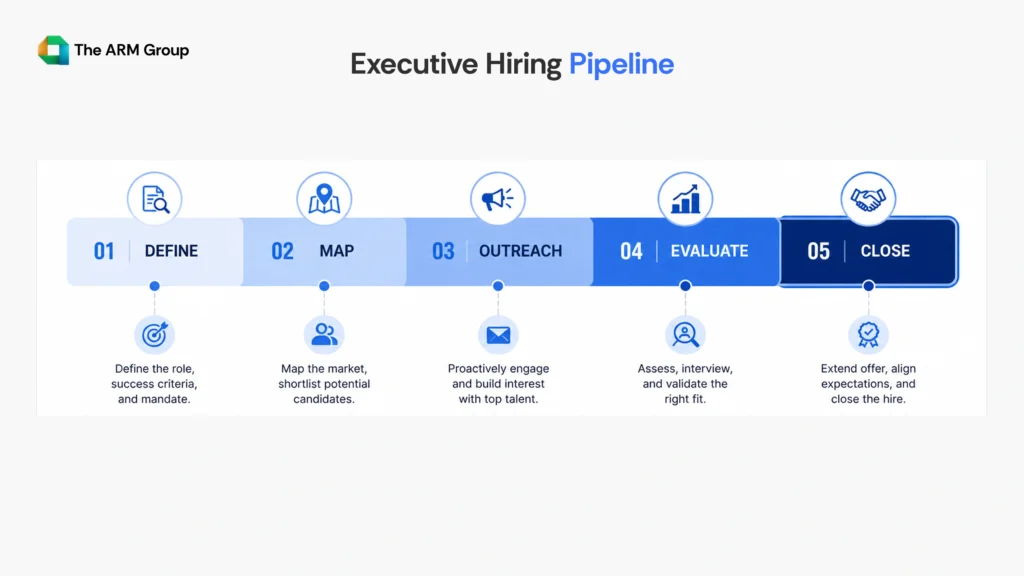
Let’s highlight the step-by-step executive search process.
- Intake meeting
It is not an ‘order-taking’ session. If you do not ask for clarity, you have to pay for it. The 30-minute call may create misalignment. Therefore, always ask why they are hiring, why the previous employee failed, and what success looks like in 90 days.
- Position
The position of a particular job is a sales pitch. The executives are not looking for work; they look for a reason to listen. This is the main reason for the specification.
- Market research
Search 50-80 individuals. If one has 100, he has not filtered the individuals. There should be no shortcuts while recruiting. The best researchers do not just search for names but find the people who are not looking to be found.
- Candidate outreach
Most of the targeted individuals are not searching for jobs. You have 15 seconds to get the executive’s attention. So, make it personal and specific.
- Profile assessment
This is the most time-consuming stage. Here, the recruiter will assess an individual’s stress level through 90-minute interviews.
- Multiple-round interviews
This is the most dangerous zone for candidate engagement. If there is a gap between rounds that takes more than a week, the disengagement increases.
- Negotiation and Closing
If the screen process is done correctly, the next step will be a formality. Your role will be to assume the counteroffer and reinforce the candidate’s original ‘why’.
Timelines for Recruiting C-Level Executives
Executive hiring for C-Suite executive search is time-intensive and cannot be rushed.
- Role definition: 1 to 2 weeks
- Market mapping: 2 to 3 weeks
- Candidate outreach: 3 to 5 weeks
- Interviews and evaluation: 3 to 4 weeks
- Offer and closure: 2 to 3 weeks
The total timeline for recruiting C-Level executives is 8 to 16 weeks. Rushed hiring often leads to poor decisions and long-term costs.
Common Failure Points
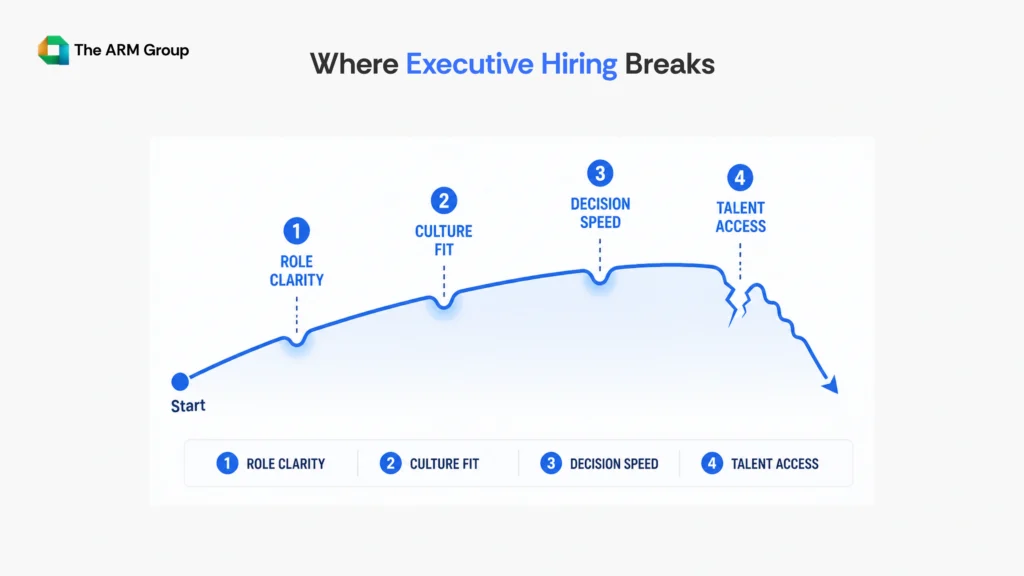
Executive hiring mistakes rarely occur. Still, some decisions made by several organizations create some risks.
These are as follows:
- Hiring for track record
The major mistake is to treat previous results as a proxy for future effectiveness. This hiring decision depends on the revenue growth and transformation delivered. When executives enter into the role with different constraints or stakeholder dynamics, there will be friction.
- Underestimating the real scope
When organizations depend on written job descriptions, they often miss the opportunity to observe day-to-day leadership in action. Formal responsibilities hold reporting lines and deliverables. They do not reflect informal influence, political complexity, or cross-functional friction, which can create misalignment.
- Ignoring leadership
Leadership behavior, including influence and conflict navigation, is assumed to appear with seniority. Usually, this assumption breaks down rapidly. Executives may have strong expertise but struggle to manage disagreements or navigate ambiguous situations.
How Does the ARM Group Support Executive Hiring?
The ARM Group approaches recruiting C-level executives through a combination of talent strategy and workforce intelligence.
Their approach focuses on:
- For businesses that need high-level decision-making support, it focuses on precision and strategic alignment. It offers a deep understanding of organizational vision and long-term goals.
- The organizations that need constant legal and operational guides, Arm Group emphasizes continuity and execution. Here, you will get end-to-end support from planning through execution, aligned with business goals and operational workflows.
- Flexibility is essential for growing organizations. The Arm Group offers flexible, long-term commitments and scalable support based on workload and business cycles. It will allow businesses to access high-quality legal guidance without cost or commitment.
With tailored solutions across industries, they help organizations reduce hiring risks and secure leadership that drives measurable impact.
FAQs
What Is The Average Time To Hire A C Level Executive?
It typically takes 8 to 16 weeks, depending on the role’s complexity and market conditions.
Why Is C Suite Executive Search Different?
It involves strategic alignment, confidentiality, and a deeper evaluation than standard hiring. Each candidate is assessed for their ability to drive transformation and sustain growth within the company’s unique culture.
What Is The Biggest Challenge In Executive Hiring?
Finding the right balance between skills, leadership ability, and cultural fit. Successful executive hiring requires a holistic approach that evaluates both measurable competencies and intangible leadership qualities.
Can Companies Handle Executive Hiring Internally?
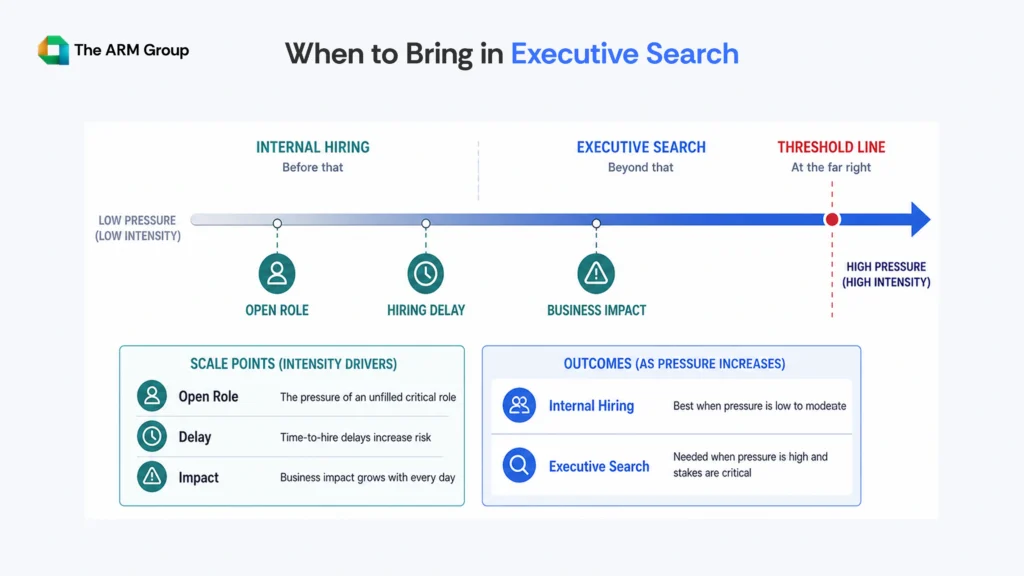
While possible, it often limits access to passive candidates and market insights. External executive search firms bring specialized networks, benchmarking data, and confidentiality protocols that help identify and attract top-tier leaders who may not be actively seeking new roles.
How Can Hiring Risks Be Reduced?
Through structured processes, clear role definitions, and data-driven decisions. Incorporating leadership assessments, reference checks, and cultural compatibility evaluations ensures that every appointment strengthens organizational stability and long-term performance.
What Qualities Define a Successful C-Level Executive?
Beyond technical expertise, successful C-level leaders show strategic vision, emotional intelligence, and adaptability. They inspire teams, navigate uncertainty, and align organizational goals with market realities to drive sustainable growth.
How Important Is Cultural Fit in Executive Hiring?
Cultural fit is critical for long-term success. Even the most skilled executive can struggle if their leadership style clashes with company values. Evaluating alignment in communication, decision-making, and team dynamics ensures smoother integration and stronger organizational cohesion.
Conclusion
Recruiting C-level executives is an important process that demands more than the traditional hiring process. It needs a structured approach, a realistic timeframe, and a strong understanding of the impact of leadership.
Businesses that invest in the right process and strategy can secure leaders who drive growth. But achieving this consistently requires more than internal effort; it requires a specialized skill set and market intelligence.
This is where the Arm Group comes in. By integrating talent strategy with workforce intelligence, they help organizations discover, assess, and secure leadership aligned with long-term business goals.
Key Takeaways:
- Executive hiring requires a structured and strategic approach that goes beyond traditional recruitment. It demands careful planning, stakeholder alignment, and a deep understanding of organizational goals to ensure every leadership appointment drives measurable impact.
- Timelines are longer but necessary for quality decisions, as senior-level searches involve extensive evaluation, discreet outreach, and cultural fit assessments. This deliberate pace ensures that each hire contributes meaningfully to long-term business success.
- Common failures can be avoided with proactive planning, including clear role definitions, succession mapping, and early engagement with decision-makers. Anticipating challenges before they arise helps maintain momentum and reduces costly missteps.
- Talent strategy and workforce intelligence improve outcomes by combining market insights, leadership analytics, and benchmarking data. These tools enable companies to identify high-potential leaders and align hiring decisions with future growth objectives.
- The right partner can significantly reduce hiring risks and improve success rates by providing access to passive candidates, confidential search processes, and proven evaluation frameworks that strengthen leadership pipelines and organizational stability.