

You hired eight people last year. Ask anyone why those eight, in that order, and you will get a shrug. Growth feels brilliant until the headcount sheet starts arguing with the budget. That is the moment most companies realise they have been guessing. A good workforce planning model ends the guessing, and it does not need a consulting budget.
Short answer: The best workforce planning model for most growing companies is demand-driven planning with a skills check layered on top. Budget-led and scenario-based approaches also work, but only at certain stages. Pick one, write it down and review it every quarter.
TL;DR
- A workforce planning model is a repeatable method for deciding who to hire, when and why.
- Four types cover most cases: headcount-based, demand-driven, skills-based and scenario-based.
- Small teams can start simple. Fast growers need demand and skills data.
- Workforce planning only helps when someone owns it and reviews it.
- Match the approach to your growth stage, not to what sounds impressive.
What Is a Workforce Planning Model and Why Should Growing Companies Care?
A workforce planning model is a method for working out how many people you need, with which skills, by when. Think of it as the recipe behind your hiring plan.
Every company has one, even if it is just “the founder’s gut.” The gut works at 15 people. Then growth outnumbers it.
Workforce planning gets harder the moment you scale. The BLS job openings and labor turnover data tracks openings and quits every month, which is a polite reminder that the labour market does not wait for your annual plan.
Which Workforce Planning Model Should You Choose?
Four approaches cover most situations. Here is the quick comparison.
| Model | How it works | Best for | Watch out for |
| Headcount-based | Sets headcount per team from budget | Small teams, tight budgets | Counts seats, ignores skills |
| Demand-driven | Forecasts roles from business plans and contracts | Steady growth | Needs reliable forecasts |
| Skills-based | Maps skills you have against skills you need | Technical, specialised teams | More data upfront |
| Scenario-based | Plans best, base and worst cases | Uncertain markets, expansion | Can turn into overthinking |
What Is a Headcount-Based Approach?
Simple and fast. Marketing gets six people, Operations gets twelve, and you hire to fill. It works at 20 people. At 200 it struggles, because it counts chairs and ignores capability.
What Is a Demand-Driven Approach?
Start from the business plan. A new contract means three more quality engineers by June. Work backwards from that date, add how long each search takes, and open roles early. Most growing companies land here.
What Is a Skills-Based Approach?
Ask what your team can do, not how many people it has. A plant can have a full maintenance crew and still lack someone who can troubleshoot automation. This is the approach that finds the hidden gap.
What Is a Scenario-Based Approach?
Plan three versions of next year: strong, steady, shaky. Decide in advance which hires move in each. It suits companies entering new markets, like Indian businesses building US teams. Keep it to three scenarios. Five is a hobby.
How Do You Match a Workforce Planning Model to Your Growth Stage?
Stage decides the fit. Use this as a starting point.
| Growth stage | Best fit | Why |
| Under 50 employees | Headcount-based | Light, quick, enough for now |
| 50 to 250 employees | Demand-driven plus skills check | Hiring pace outgrows gut feel |
| Entering new markets | Scenario-based plus demand-driven | Uncertainty needs backup plans |
| Specialised or technical teams | Skills-based | Capability gaps cost more than empty seats |
Most companies blend. Pick one workforce planning model as the spine and borrow pieces from the others.
Lead times change by industry too. A maintenance role in manufacturing, an engineer in IT and technology, a manager in logistics and transportation and a quality lead in pharmaceutical and medical devices all fill on different clocks. Build that into the plan.
What Data Does Your Model Need?
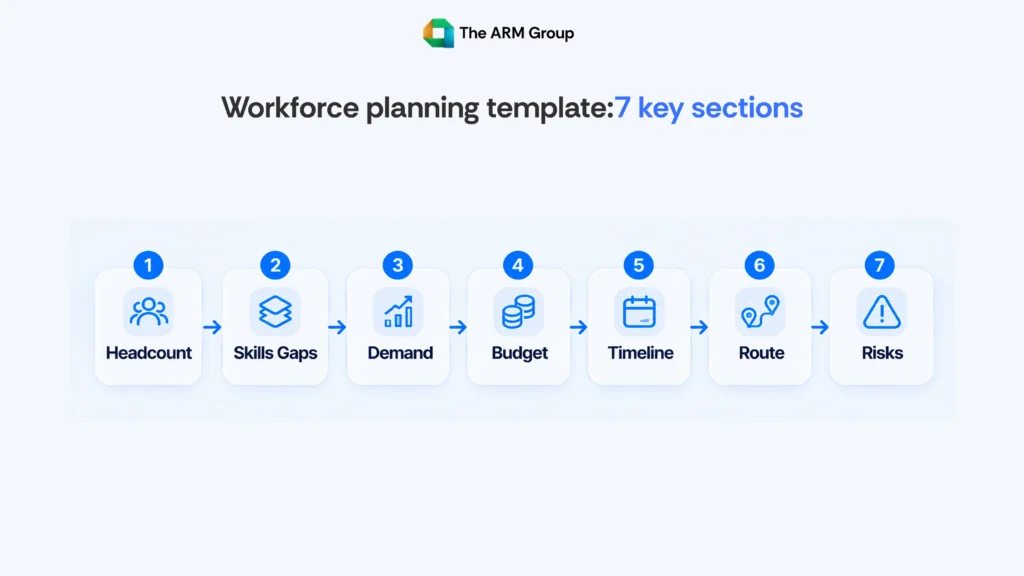
Good workforce planning starts with data you already have. Five inputs do most of the work:
- Current headcount by team, location and employment type.
- Skills inventory covering what your people can actually do.
- Business plan with new contracts, launches and offices.
- Attrition history showing who tends to leave and when.
- Time to fill for each role.
Time to fill is the one people skip. If you need someone in June and the search takes eight weeks, the role must open in early April. The BLS Occupational Outlook Handbook helps you check which occupations are growing.
Planning contract roles? Check worker classification rules with the U.S. Department of Labor first. Boring step. Expensive if skipped.
What Mistakes Break a Hiring Plan?
We have seen this before. These show up again and again:
- The Oversized Model: a 40-tab plan for a 30-person company that nobody opens.
- The Seat Counter: tracks people, ignores skills.
- The Missing Lead Time: forecasts the need, forgets the search takes weeks.
- The Ownerless Plan: everyone’s job, so nobody’s job.
Workforce planning is a loop, not a project. One owner, one shared document, one review date.
Why Growing Companies Choose The ARM Group to Turn Hiring Plans Into Hires
A plan on paper does not fill a single role. The ARM Group does. We work with 85+ clients across 27+ countries and deliver pre-vetted shortlists in 24 to 48 hours, so the roles your workforce planning keeps flagging do not sit open for months.
Once your workforce planning model shows where the gaps are, we match each one to a route. ARM Elite runs executive search for C-suite, VP and Director roles. ARM Professional handles sourcing, screening and coordination from intake to offer for growing functional teams. ARM Flexi scales recruiting support up or down for ramp-ups and seasonal spikes. For urgent, hard-to-fill roles, hybrid direct placement combines targeted sourcing and screening so you are not starting from zero.
For Indian companies building US teams, we run the full recruiting cycle from India with US execution, with no in-house US HR team needed and no long-term lock-in. Send us your plan and we will map each row to a route, a timeline and a shortlist.
Frequently Asked Questions
What is a workforce planning model?
It is a repeatable method for deciding how many people you need, with which skills and by when. Common types are headcount-based, demand-driven, skills-based and scenario-based.
Which model is best for a growing company?
Demand-driven planning with a skills check suits most. It ties hiring to real business plans and catches capability gaps before they slow delivery.
What are the main types of workforce planning?
Headcount-based, demand-driven, skills-based and scenario-based. Each suits a different stage, from small teams to companies entering new markets.
How often should I review my hiring plan?
Quarterly at minimum. Update it right after a resignation, new contract, budget change or expansion.
Can I combine more than one model?
Yes. Most companies use one as the base and borrow pieces from the others, such as adding a skills check to a demand-driven plan.
Do small companies need a formal plan?
Yes, a simple one. A one-page headcount plan helps small teams spot gaps early and budget for hiring costs.
Key Takeaways
- A planning model is just a repeatable method, so choose the simplest one that still answers who, when and why.
- Headcount-based planning suits small teams, but it counts seats and quietly ignores the skills your work depends on.
- Demand-driven planning works backwards from contracts and launches, which is why most growing companies end up using it.
- Skills-based planning finds the hidden gap, such as a full crew that still cannot troubleshoot automation systems.
- Scenario-based planning prepares you for uncertainty, but keep it to three versions or it becomes overthinking.
- Match your approach to growth stage, then blend pieces from other methods instead of forcing one to do everything.
- Time to fill is the input most teams skip, so add it to every role before setting a start date.
- Lead times differ by industry, so manufacturing, IT, logistics and pharma roles should never share one timeline.
- Give the plan one owner and one review date, or it becomes a spreadsheet nobody opens.
- Check contractor classification rules with the Department of Labor before planning any non-employee roles.
Conclusion
The right workforce planning model helps you make hiring decisions based on where your business is going, not just where it stands today. Start with a simple approach, add skills checks as your team grows, and use scenario planning when expansion brings uncertainty. The key is to keep your plan practical, assign ownership, and review it every quarter so hiring stays aligned with business needs.
Pick one workforce planning model, write it down, give it an owner and open it every quarter. Start simple. Add skills and scenarios as you grow. Future you, the one not panicking over a resignation, will be grateful.
Ready to Fill the Roles in Your Plan?
Click here to get a quote and talk to a real recruiter, or call us at +1 803-830-7396 (US) or +91 96630-35271 (India).
P.S. Which model is your company secretly running right now: spreadsheet, gut or vibes?