
An end to end recruitment process starts long before a candidate accepts an offer. You found the perfect candidate. They said yes on Friday. By Wednesday, they’ve stopped replying.
Here’s what nobody tells you: many hiring stories don’t fall apart at the interview. They fall apart in the gaps between steps.
The end to end recruitment process covers every step from defining the role to a new hire’s first productive day: intake, sourcing, screening, interviews, offer, checks, and onboarding. A clear process closes the gaps where good candidates vanish. Many teams call this full cycle recruitment. Here’s how to manage each stage.
TL;DR
- The end-to-end recruitment process has seven stages, from intake to onboarding.
- Full cycle recruitment means one team owns every stage, so nothing drops between handoffs.
- Delays usually come from the gaps between stages, not from bad candidates.
- The stretch between offer and day one is the riskiest, so keep candidates warm.
- Compliance steps like background checks and Form I-9 belong in the plan from the start.
Table of Contents
- What Is an End-to-End Recruitment Process, and Why Does It Matter?
- What Are the Stages of the End-to-End Recruitment Process?
- How Do Sourcing and Screening Really Work?
- Why Do Hires Fall Apart Between Offer and Day One?
- What Does Onboarding Add to the Process?
- How Does the Process Change by Industry?
- Why Is The ARM Group the Right Partner for Full Cycle Recruitment?
- Where Should You Start?
- Frequently Asked Questions
- Key Takeaways
What Is an End-to-End Recruitment Process, and Why Does It Matter?
An end-to-end recruitment process covers the whole journey, from “we need someone” to “they’re settled in and doing great work.” One owner. One timeline. No dropped batons.
Think of a relay race. The fastest runners still lose if the baton drops at the handoff. Hiring works the same way.
Without a joined-up process, intake sits with the manager, sourcing with a recruiter, offers with HR, and onboarding with IT. Four teams, four inboxes, zero shared timeline.
A single owner fixes this by putting one team in charge of every stage. Fewer handoffs means fewer places to lose a candidate.
What Are the Stages of the End-to-End Recruitment Process?
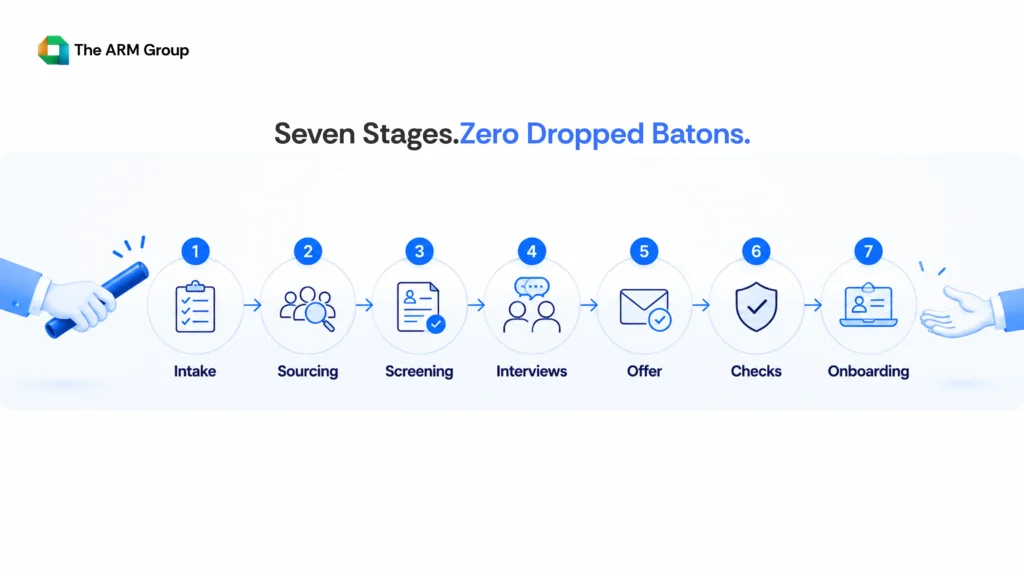
Seven stages. Each one hands off to the next, and each handoff is a place to lose someone.
| Stage | What Happens | Where It Often Breaks |
| 1. Intake | Define the role, must-haves, pay range, timeline | A vague job brief |
| 2. Sourcing | Find active and passive candidates | Only posting ads and waiting |
| 3. Screening | Check skills, motivation, availability | Resume-only checks |
| 4. Interviews | Structured rounds, then a shortlist | Too many rounds, slow feedback |
| 5. Offer | Negotiate and confirm terms | Surprises on pay or work mode |
| 6. Checks | Background, references, work authorization | Late starts and delays |
| 7. Onboarding | Prepare day one and the first months | Day-one chaos |
How Do Sourcing and Screening Really Work?
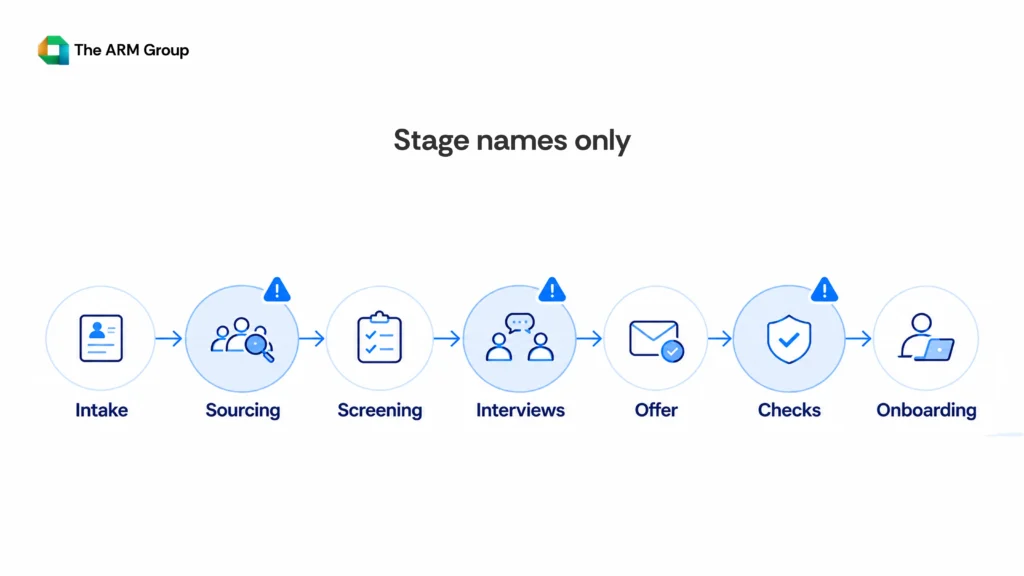
Honestly, the person you need probably isn’t job hunting. Great candidates are busy doing great work somewhere else. That’s why good sourcing means going to them, not just posting an ad.
Screening is where most processes quietly leak. Here’s the named mistake: the Resume-Only mistake. You shortlist on keywords, run three interview rounds, then discover the candidate wants fully remote and the role is on-site. Six weeks gone.
The fix is simple. Ask three questions in the first screen: pay range, work location and mode, and start date. A resume tells you what someone did. A screening call tells you what they want.
Why Do Hires Fall Apart Between Offer and Day One?
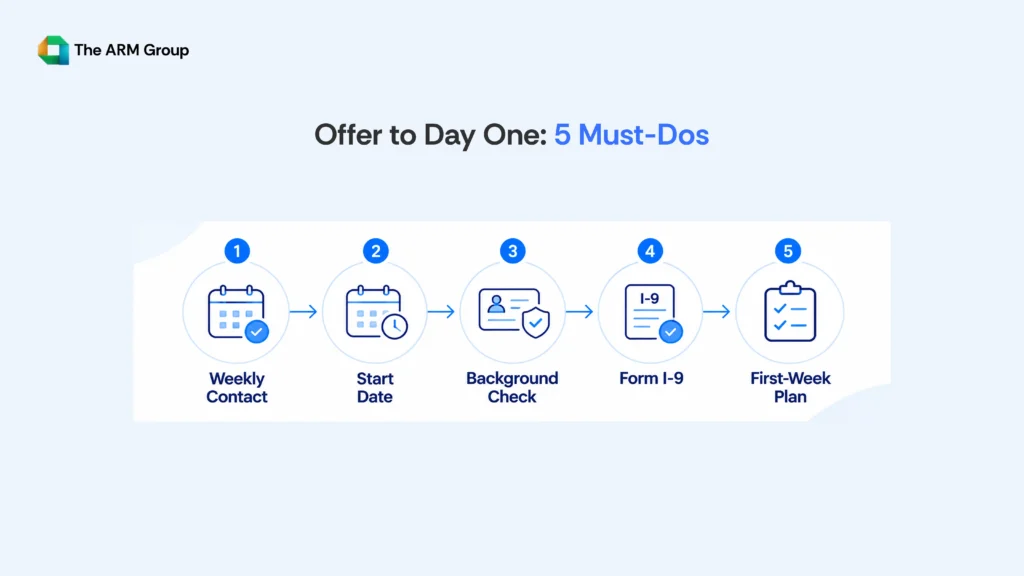
Because everyone relaxes too early. The offer goes out, the team exhales, and silence fills the gap. Silence is exactly when a competing offer shows up.
Picture a candidate who accepts on Friday (a hypothetical, but a familiar one). Nobody calls until the start date. By then, another employer has called twice. The fix: keep in touch weekly, confirm the start date, and share what day one looks like.
This stretch also carries the compliance steps. For background checks, the EEOC and FTC guidance says to treat every candidate the same way and get written permission before using a third party. For US hires, Form I-9 is due too: the employee completes Section 1 by day one, and you complete Section 2 within three business days.
What Does Onboarding Add to the Process?
Onboarding is not orientation. Orientation is paperwork and a tour. SHRM’s onboarding guide notes that real onboarding involves managers and colleagues and can last up to 12 months.
A strong end-to-end recruitment process treats day one as a deliverable. It includes:
- A clear first-week plan with named people.
- Tools and access ready before the start date.
- A buddy who answers the small questions.
- A check-in at 30, 60, and 90 days.
Skip this and you may win the hire but lose the person.
How Does the Process Change by Industry?
The stages stay the same. The pressure points move.
- Pharma and medical devices: Credentials and quality experience need careful verification. See pharmaceutical and medical devices hiring solutions.
- Banking captives (GCCs and GICs): Several stakeholders sign off, so interview coordination matters most. See banking captives hiring solutions.
- Automation and robotics: Specialist skills are scarce, so sourcing must start early. See automation, robotics and Industry 4.0 hiring solutions.
An end-to-end recruitment process that ignores your industry’s pressure points is just a checklist.
Why Is The ARM Group the Right Partner for Full Cycle Recruitment?
The ARM Group runs the whole journey, from intake call to a shortlist of pre-vetted candidates in 24 to 48 hours, with no commitment to start. You get real recruiters on every stage instead of four teams passing a baton. That’s full cycle recruitment built for hiring teams that can’t afford dropped handoffs.
Each service covers a different need. ARM Professional handles mid-to-senior hiring from intake to offer. ARM Elite runs leadership searches with curated shortlists and rigorous screening. ARM Flexi scales contract, temp, and volume hiring up or down. When one role can’t wait, Hybrid Direct Placement pairs targeted sourcing with screening to fill it faster.
Here’s a real-world fit. An Indian company opening a US office can hand us the full process without building a US HR team first. That’s the point of “India Control. US Execution.”
Frequently Asked Questions
What is an end-to-end recruitment process?
It covers every step from defining the role to a new hire’s first productive day. That includes intake, sourcing, screening, interviews, offer, checks, and onboarding.
What is full cycle recruitment?
It means one team or recruiter manages every hiring stage, from intake to onboarding. That removes handoffs, which are where candidates and time usually get lost.
What are the stages of the end-to-end recruitment process?
Seven: intake, sourcing, screening, interviews, offer, checks, and onboarding. Each stage hands off to the next, so tight communication between them matters as much as the stages themselves.
Who owns the process in a full-cycle model?
One owner, usually a recruiter or recruitment partner, manages the process and coordinates hiring managers, HR, and candidates. Managers still make the final hiring decision.
When should a company outsource its end-to-end recruitment process?
Consider it when you lack an in-house recruiting team, are hiring in a new market, or face a surge in roles. A recruitment partner can take over from intake to offer.
What happens after a candidate accepts the offer?
Background checks, work authorization paperwork, and onboarding prep begin. Stay in touch weekly until day one so the candidate doesn’t go quiet or accept another offer.
Key Takeaways
- The process runs from role intake to a new hire’s first productive day.
- One team owning every stage means candidates don’t fall between handoffs.
- Most delays hide in the gaps between stages, not in the stages themselves.
- Ask about pay, work mode, and start date in the first screen to avoid late surprises.
- Silence after the offer invites competing offers, so stay in weekly contact until day one.
- Treat background checks equally for every candidate and get written permission before using third-party reports.
- Complete Form I-9 on time: Section 1 by day one, Section 2 within three business days.
- Onboarding goes beyond orientation and can last months, so plan the first 90 days in advance.
- Every industry has its own pressure point, so tailor the process rather than copying a generic checklist.
Conclusion
A successful hire doesn’t end with an accepted offer. It takes a well-managed recruitment process to move candidates from the first conversation to their first productive day without unnecessary delays or missed handoffs. By keeping every stage connected, staying in touch after the offer, and planning onboarding early, you can reduce hiring delays and give new employees a stronger start.
Look at your last hire. Where did it slow down? That one gap is your starting point, and fixing it beats rebuilding everything at once.
Ready to hand off your end-to-end recruitment process? Click here to get a quote, or call us on +1 803-830-7396 (US) or +91 96630-35271 (India).
P.S. Where did your last hire slow down? That’s where we’d start.