


Recruiting leaders requires more effort than people expect based on what they see in recruitment documents. According to SHRM, the median time-to-fill for executive roles is 45 days.
You begin with a clear picture of the person you need: someone with proven experience and strategic thinking skills, and the confidence to lead teams through growth. The job description is approved, interviews begin, and everyone involved has high expectations. Then the process starts to slow down.
The initial assessment of profiles shows strengths, but the interview process reveals gaps in leadership style, skills, and long-term compatibility. Some candidates have appropriate experience but lack a vital understanding of the industry. The hiring process has been delayed for several weeks or months because there is no indication of any forthcoming results.
Organizations reach this point when they begin investigating executive search firms. They need to hire, but the process no longer meets leadership recruitment standards.
This guide first explains the executive hiring methods used by top firms, then shows how to select the right executive hiring partner, and finally outlines how The Arm Group can help your organization succeed.
What Are Executive Hiring Firms?
Executive hiring firms specialize in sourcing and placing talent for hard-to-fill roles, especially leadership, VP, director, and C-suite positions, where an executive search model like ARM Elite offers targeted executive search services.
These include:
- Leadership and management roles
- C-suite and senior executive positions
- Niche or highly specialized roles
- Business-critical strategic hires
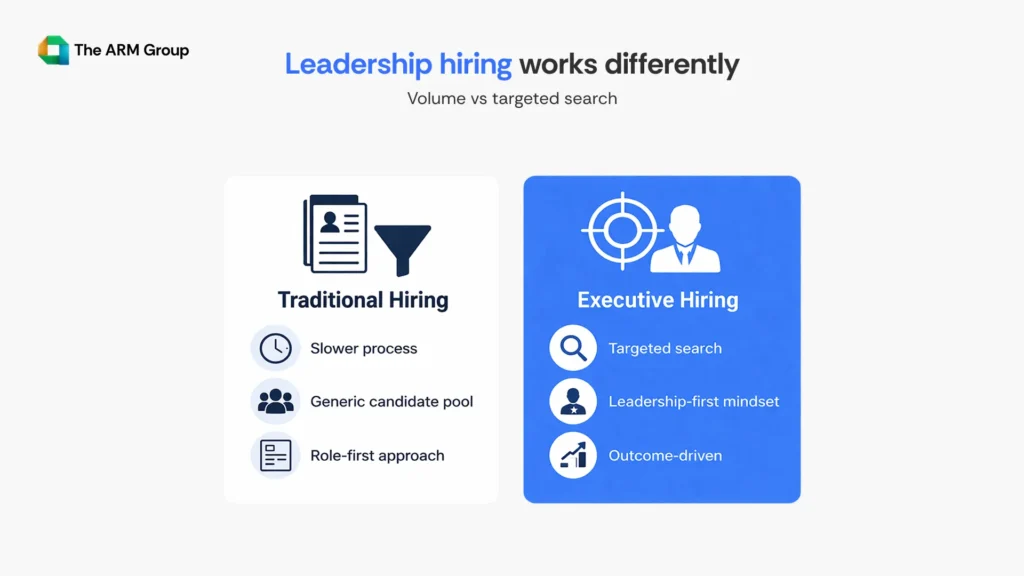
Executive hiring processes use executive search methodologies, relying on proactive talent mapping, direct sourcing, and market intelligence rather than standard inbound recruitment methods. This approach increases the precision of hiring key talent.
Instead, the process is far more targeted.
Identify high-impact executives currently succeeding in peer organizations.
- Engage passive executive candidates through targeted outreach.
- Evaluate talent beyond résumé keyword screening by using in-depth executive assessments.
- Evaluate leadership style, business fit, and long-term alignment.
This distinction matters.
The strongest leadership candidates are often not actively applying for jobs. They may already be employed, performing well, and open only to the right opportunity.
This is where executive hiring firms deliver strategic value by accessing leadership talent pools typically inaccessible to standard recruitment channels.
This is particularly relevant when previous efforts have failed to yield the right leadership profiles.
For a structured view of leadership-focused hiring support, you can direct to The Arm Group.
Why Leadership Hiring Feels Different?
Senior executive hiring requires advanced talent acquisition techniques. Organizations face greater complexity in identifying highly qualified executives than in increasing the number of applicants.
A senior hire directly impacts business outcomes, team dynamics, and the selection of future business directions. The situation carries higher risks as a result.
A few factors make leadership hiring more complex:
- Limited Talent Pool
The more senior the executive role, the smaller the talent pool. Hiring targets a limited set of qualified executives with the required background.
- Higher Stakeholder Expectations
Founders, HR leaders, department heads, board members, and investors may all have a say in the process. This naturally adds layers of review and alignment.
- Culture and Leadership Style Matter
At this level, technical capability alone is not enough.
The candidate must align with:
- Company Values
- Team Dynamics
- Leadership Philosophy
- Communication Style
- Growth Vision
A technically strong candidate who cannot lead teams may still be the wrong fit.
- Higher Cost of a Wrong Hire
A wrong leadership hire impacts far more than one role.
It can affect:
- Employee Morale
- Team Productivity
- Retention
- Revenue Goals
- Operational Continuity
This is why leadership hiring often takes longer and demands more structured evaluation.
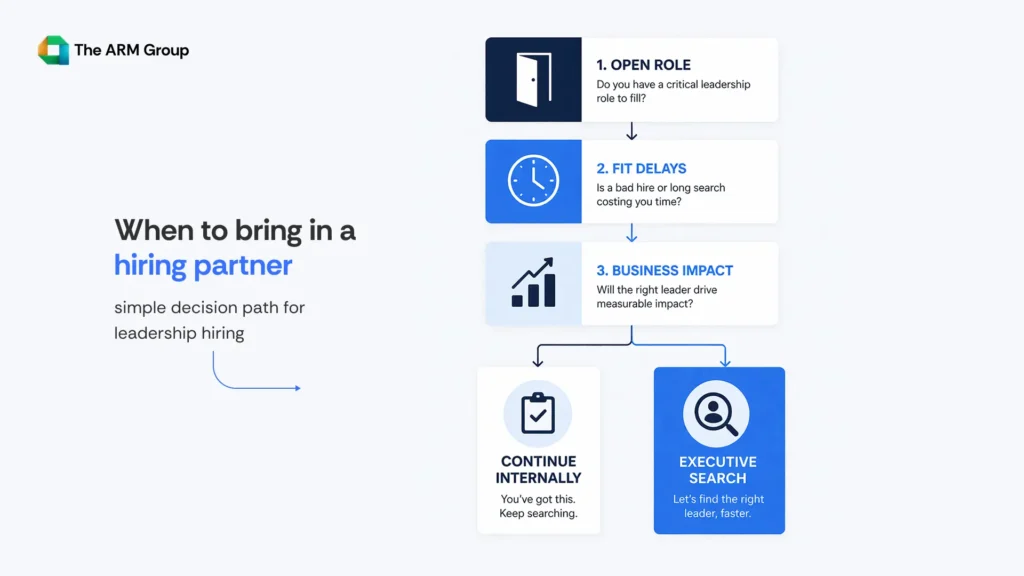
When Should You Work With One?
Most businesses start leadership hiring internally, and that is usually the right first step. However, there are clear signs that it may be time to bring in an executive hiring partner.
- The Role Has Been Open Too Long
If the hiring process for a senior position will take longer than planned, the existing hiring methods are ineffective at finding suitable candidates.
The time it takes to hire for leadership positions has a major impact at this level, as it delays decisions across multiple teams.
- You’re Seeing Candidates, But Not the Right Fit
Sometimes the problem is not volume. You may be receiving profiles, scheduling interviews, and still not finding the right alignment.
This typically signals a talent-sourcing challenge rather than a pipeline-volume issue.
- Interviews Are Not Converting
If promising profiles do not advance in later interviews, screening criteria likely need more role-specific definition.
Executive hiring firms refine leadership fit by applying role-specific screening criteria early in the search process.
- The Role Requires Specialized Leadership Experience
For these business-critical leadership and specialist roles, services like ARM Professional can help improve both search quality and time-to-hire.
For example:
- Healthcare Leadership
- Technology Leadership
- Finance and Compliance Heads
- Regional Expansion Leaders
In these scenarios, access to deep specialist talent networks within the search firm’s reach is critical.
- Confidential Hiring Is Needed
Some leadership hiring needs discretion. This may include replacement hiring, expansion planning, or strategic restructuring.
Executive search firm partners are often better equipped to manage confidential outreach.
How to Choose the Right Hiring Partner?
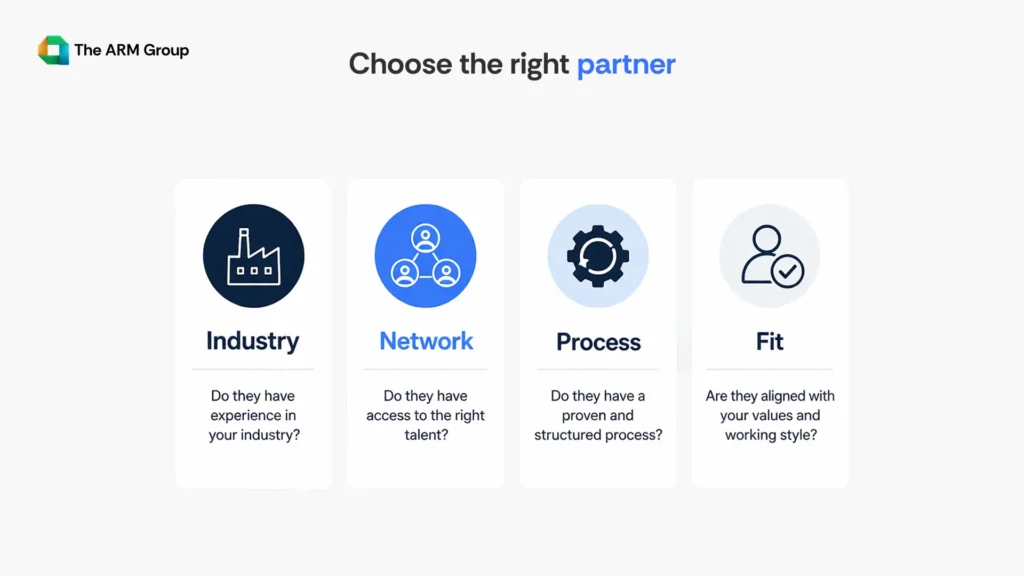
Not all executive hiring firms operate the same way. Choosing the right one can significantly impact both speed and quality of hiring.
Here is what to look for.
- Industry Understanding
A strong hiring partner should understand your industry beyond surface-level terminology.
Ask:
- Do they understand role expectations?
- Do they know competitor talent pools?
- Can they assess domain-specific leadership experience?
A firm with relevant industry familiarity usually shortens the hiring cycle.
- Candidate Network
The value of an executive hiring firm lies in access. They should be able to reach candidates beyond public job portals. This includes passive talent and established leaders who may not be actively job searching.
- Process Clarity
A structured process reduces confusion.
Ask them to walk you through:
- Sourcing
- Market Mapping
- Screening
- Interview Coordination
- Feedback Timelines
- Offer Support
Clarity here often reflects operational maturity.
- Quality Over Volume
More profiles do not necessarily mean better hiring. A strong partner prioritizes relevance over quantity. Three highly aligned profiles are often more valuable than twenty loosely matched resumes.
- Communication and Feedback Rhythm
Leadership hiring requires fast and consistent communication.
Choose a partner that follows disciplined feedback loops and keeps momentum moving.
Common Mistakes That Slow Hiring Down
Many hiring delays are process-driven. In situations where teams need immediate continuity while the permanent search continues, flexible support options like ARM Flexi can help bridge the gap.
Some of the most common mistakes include:
- Treating Leadership Hiring Like Standard Hiring
Senior roles require deeper evaluation. Applying a standard recruitment workflow often creates mismatches.
- Delayed Interview Feedback
The longer it takes for stakeholders to respond, the more likely it is that candidates with strong potential will lose interest or accept positions elsewhere.
- Changing Requirements Mid-Process
Shifting expectations midway causes major delays. This includes changing experience requirements, reporting structure, or leadership scope.
- Working With Too Many Partners
The approach of using multiple firms simultaneously appears to save time, but it creates confusion for candidates through operational duplication and redundant processes.
A focused partnership usually performs better.
What to Expect From the Hiring Process?
A structured executive search firm usually follows these stages:
- Role Discovery
This goes beyond the JD.
The hiring firm understands:
- Business objectives
- Leadership expectations
- Team structure
- Reporting lines
- Success metrics
- Market Mapping
Potential candidates are identified across relevant companies and sectors.
- Candidate Outreach
Direct and discreet outreach begins. This is where passive talent engagement becomes important.
- Screening and Evaluation
Candidates are assessed at executive search firms for:
- Leadership Experience
- Deciding Ability
- Role Fit
- Business Maturity
- Cultural Alignment
- Shortlisting
Only qualified and relevant profiles are presented.
- Interview Coordination
The firm helps streamline stakeholder schedules and candidate communication.
- Offer and Closure
Negotiation and closure support help reduce drop-offs at the final stage.
This structure reduces back-and-forth and helps leadership hiring move with more confidence.
How The Arm Group Supports Leadership Hiring?
When leadership hiring becomes unpredictable, the process at executive search firms becomes the difference-maker.
The Arm Group focuses on leadership and niche hiring needs through a structured, role-first approach.
Their support includes:
- Leadership hiring through ARM Elite
- Specialized and niche roles through ARM Professional
- Flexible hiring continuity through ARM Flexi
- Focused candidate shortlisting
- Faster turnaround
- Stronger role alignment
The organization shifts its focus from counting resumes to finding candidates who exactly meet all business needs.
This helps companies reduce delays and make stronger leadership decisions.
FAQs
What do executive hiring firms do?
They help businesses hire senior and leadership talent through targeted sourcing, market mapping, and structured evaluation.
Are they better than internal hiring?
Not always. They are most useful when internal hiring efforts are slowing down or not producing the right leadership fit.
How long does leadership hiring take?
Timelines vary by role complexity, but structured executive hiring processes often significantly reduce delays.
Do they help with confidential hiring?
Yes, many executive search firms specialize in discreet, confidential searches.
Conclusion
Leadership hiring is not just about filling a vacancy. It is about making a business-critical decision that affects people, performance, and long-term growth.
The right executive hiring partner helps you move faster, improve hiring quality, and reduce costly mismatches. When the process starts slowing down, structured support can make the difference between a delayed hire and the right leadership decision.
If your leadership hiring process is slowing down or critical roles have remained open longer than expected, contact The Arm Group to discuss a more structured hiring approach.
Key Takeaways:
- Hiring for leadership roles requires a different process than standard recruitment.
- The right executive hiring firm improves both speed and quality.
- Most hiring delays come from process gaps, not candidate shortage.
- Industry understanding and network access matter when choosing a partner.
- Structured screening improves long-term leadership fit.