


Hiring rarely breaks down at the beginning. The role gets approved, the job goes live, resumes start coming in, and interviews are lined up. On the surface, it looks like progress is happening. But then the process starts to drag.
Weeks pass. Sometimes months. You are reviewing profiles, speaking with candidates, and moving people through rounds, yet the right hire never quite materializes. As hiring timelines stretch, the cost of executive recruitment has risen sharply, with the cost-per-hire for executives increasing by 113% since 2017.
Maybe the profiles look strong on paper, but fall short in interviews. Maybe the candidates are qualified, but not at the leadership level the role demands. Or maybe the process itself keeps stretching because the right person simply is not entering the funnel.
This is usually the point where companies stop and ask: Do we need to hire an executive recruiter? It is a practical question, especially when leadership hiring starts affecting business momentum.
If you are in that situation, this guide walks through what actually changes when you hire an executive recruiter, how The Arm Group approaches leadership hiring support, when it makes sense to do so, what costs to expect, and how the process works behind the scenes.
What Does an Executive Recruiter Do?
At the most basic level, an executive recruiter helps you hire candidates. But in practice, it works very differently from standard recruitment.
Traditional hiring depends heavily on inbound applications. You post a role, wait for candidates to apply, and then begin screening from the pool. That approach works well for many mid-level and general hiring roles. Leadership hiring is different.
The strongest candidates for senior and executive positions are often not actively applying for jobs. They are already employed, performing well, and not spending time on job boards.
That is why traditional hiring often reaches a limit.
Executive recruiters do not wait for applications. This is where specialized executive recruiting services like ARM Elite become especially valuable for leadership and C-suite roles.
They proactively go into the market and identify the right people.
This includes:
- Mapping the talent landscape
- Identifying relevant leaders in similar roles
- Directly reaching out to passive candidates.
- Screening for leadership fit
- Matching compensation and expectations early
The focus is not just on resumes.
It is on leadership capability, maturity, team management style, and business alignment.
This becomes especially important when the role requires:
- Niche expertise
- Domain leadership experience
- Confidential replacement hiring
- Rapid business-critical closure
For businesses facing high-impact leadership vacancies, this structured search process often delivers faster, stronger outcomes.
When Is It Worth Hiring One?
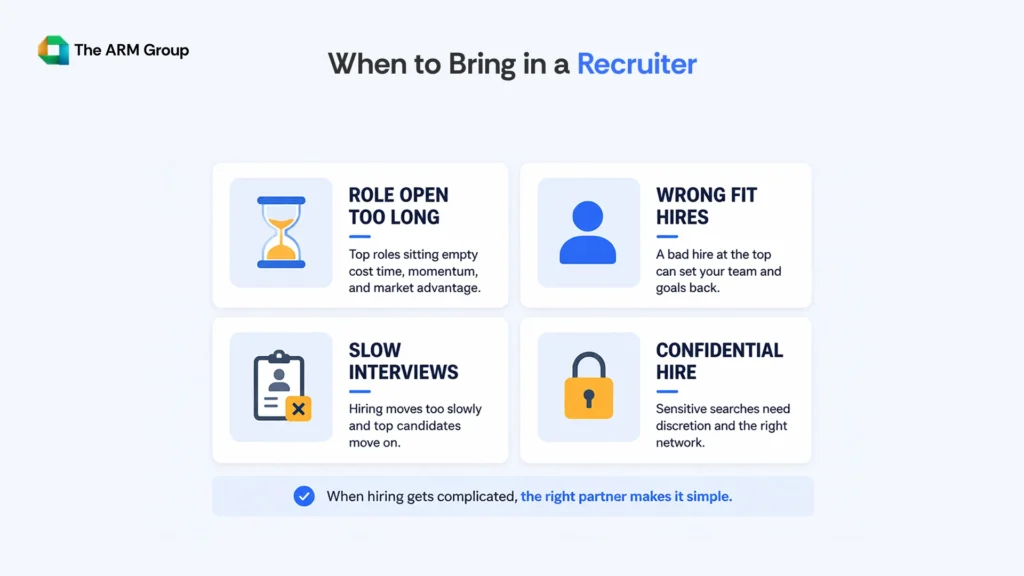
Most companies do not begin by hiring an executive recruiter. They start internally, which is usually the right first move. But there are clear signals that indicate internal hiring may no longer be enough.
- The Role Has Been Open for Too Long
If a leadership role has been open for significantly longer than expected, it is often a sourcing issue rather than a screening issue.
An open senior position can slow:
- Team Direction
- Decision-making
- Department Performance
- Project Execution
The longer it stays vacant, the more the business impact grows.
- You’re Getting Candidates, But Not the Right Fit
Sometimes the problem is not volume. You may already be seeing plenty of resumes. But if interviews repeatedly reveal misalignment, the issue is usually candidate quality or search targeting.
This is where executive recruiting services improve fit.
- Interviews Aren’t Converting Into Offers
If candidates are dropping off after advanced rounds, or stakeholders repeatedly reject profiles late in the process, it often signals a mismatch in sourcing criteria.
A recruiter helps solve this earlier.
- The Role Requires Very Specific Experience
For specialized functional leadership roles, solutions like ARM Professional can help improve sourcing quality and role fit. Senior hiring often needs highly specialized leadership backgrounds.
For example:
- VP of Sales for SaaS
- CFO with fundraising experience
- Healthcare operations leadership
- Regional market expansion heads
These are not roles that broad job portals always solve efficiently.
- You Need Confidentiality
Some leadership hires need discretion.
Examples include:
- Replacing an Existing Leader
- Confidential Restructuring
- Succession Planning
- Strategic Expansion
Executive recruiters are usually better equipped to manage discreet outreach.
At this point, working with a focused hiring partner often improves both speed and quality.
What Does It Cost, And Is It Justified?
Cost is usually the biggest hesitation. And it is a fair question. Executive recruiters charge between 15% to 30% of the candidate’s annual salary.
For example, if the leadership’s annual compensation is ₹50 lakhs or $200,000, the recruiter fee may fall within that percentage range depending on the engagement model.
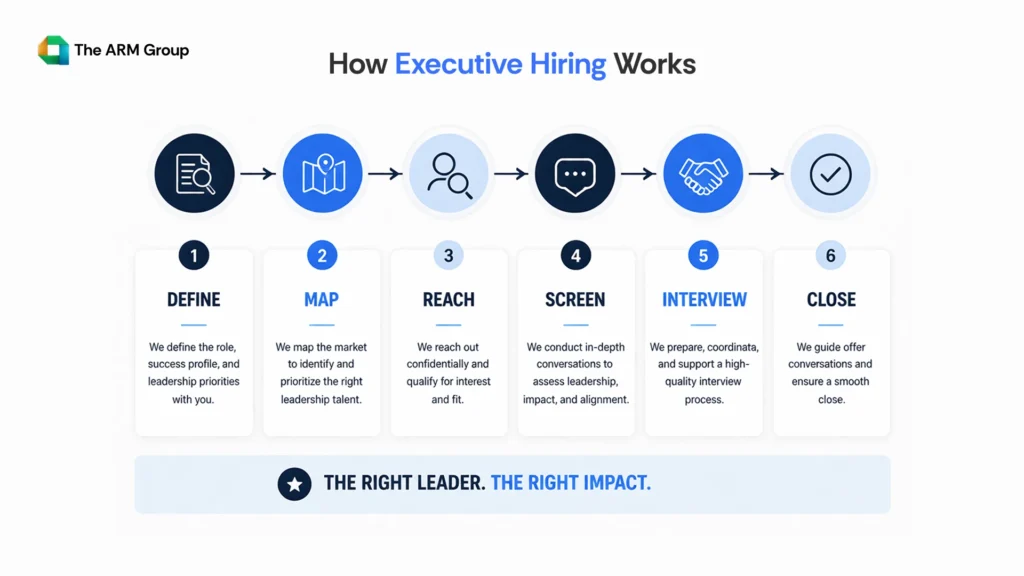
At first glance, this can feel expensive. But most businesses do not evaluate it as a standalone fee. They compare it against the cost of delay. That is the more practical lens.
The Hidden Cost of Delayed Hiring
A delayed leadership hire often affects far more than one seat.
It can lead to:
- Slower team decisions
- Project bottlenecks
- Lack of department direction
- Revenue impact
- Missed growth opportunities
For example, if a senior sales leader role remains vacant for three months, pipeline execution and team accountability may suffer significantly.
The cost of delay can easily exceed the cost of recruiting. In situations where teams need immediate continuity while a permanent search is underway, ARM Flexi can support urgent, flexible hiring requirements.
So the real comparison is not recruiter fee vs. no fee, but cost of delay vs. cost of faster closure.
When viewed this way, the investment often becomes easier to justify.
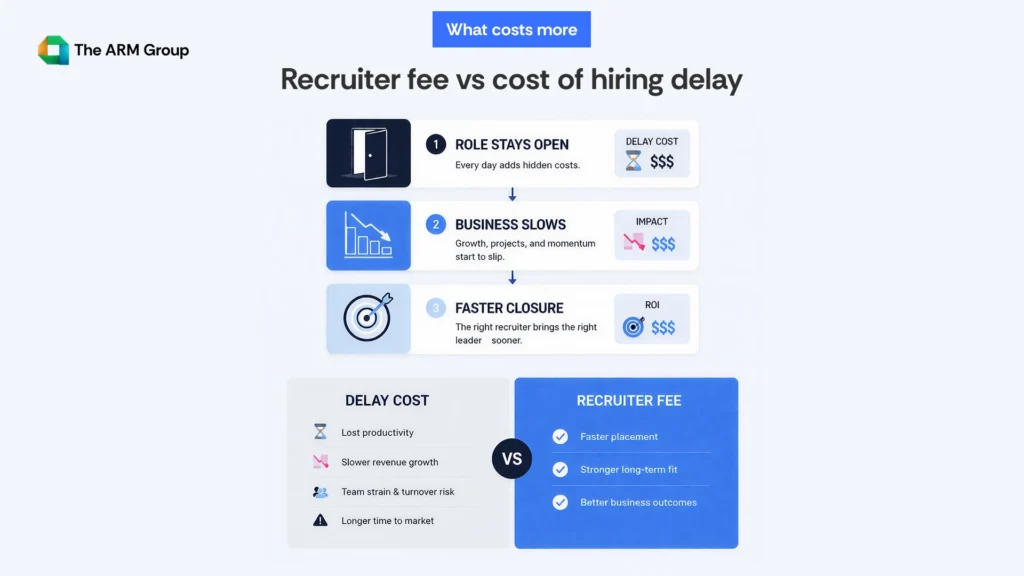
How the Executive Hiring Process Works?
The executive hiring process is usually more structured than standard recruitment.
Here is what it looks like:
- Role Understanding
The recruiter starts by understanding far more than the job description.
This includes:
- Business Objectives
- Team Context
- Leadership Expectations
- Reporting Structure
- Success Metrics
- Compensation Range
This step is critical because an unclear role definition can lead to delays later.
- Market Mapping
The next step is identifying where suitable candidates are likely to be.
This includes:
- Competitor Companies
- Adjacent Industries
- Talent-rich Sectors
- Internal Market Benchmarks
- Candidate Outreach
Instead of waiting for inbound applications, the recruiter directly approaches relevant candidates.
This is where passive talent sourcing becomes valuable.
- Screening & Shortlisting
Candidates are evaluated beyond resumes.
This usually includes:
- Leadership Experience
- Team Size Handled
- Business Impact Delivered
- Strategic Capability
- Culture Fit
Only shortlisted profiles move forward.
- Interview Coordination
The recruiter helps coordinate interviews, manage scheduling, and keep both sides aligned. This helps reduce delays.
- Offer & Closure Support
The final stage often includes:
- Compensation Discussions
- Negotiation Support
- Expectation Management
- Notice Period Coordination
This structured workflow is where specialized firms often bring clarity.
Common Hiring Delays Companies Overlook
Many hiring delays do not happen because candidates are missing. They happen because of process gaps.
- Delayed Feedback After Interviews
Slow internal feedback often causes strong candidates to lose interest. Leadership talent usually has multiple options. Speed matters.
- Unclear Role Expectations
If stakeholders are not aligned on what success looks like, the search keeps shifting. This creates repeated resets.
- Changing Requirements Mid-Process
Changing scope, experience level, or compensation midway often forces the search to restart.
Small process gaps like these can lead to major hiring delays over time.
When You Might Not Need a Recruiter?
There are situations where an executive recruiter may not be necessary.
For example:
- The Role Is Mid-Level or Junior
Standard hiring channels may work perfectly well here.
- You’re Already Getting Strong Candidates
If candidate quality is already high and interviews are progressing well, internal hiring may be enough.
- The Hiring Timeline Is Flexible
If the role is not business-critical and can stay open longer, internal hiring can continue.
- Budget Is a Major Constraint
For smaller businesses or early-stage teams, recruiter fees may not be practical.
In these situations, internal hiring often remains the better route.
How The Arm Group Supports Leadership Hiring?
When leadership hiring becomes slow, unpredictable, or difficult to close, structure becomes critical.
The Arm Group focuses on:
- Executive and leadership hiring through ARM Elite
- Niche skill-based roles through ARM Professional
- Targeted candidate sourcing
- Faster turnaround without compromising fit through ARM Flexi
- Long-term leadership fit
Rather than sending high volumes of profiles, the focus is on quality, role alignment, and long-term leadership fit.
FAQs
How much does an executive recruiter charge?
Usually between 15% and 30% of the candidate’s annual salary, depending on the role level and engagement structure.
Is hiring a recruiter worth it?
Yes, especially when internal hiring is taking too long or not producing the right leadership fit.
How long does executive hiring take?
It varies by role complexity, but a structured process usually significantly reduces delays.
Do executive recruiters help with confidential searches?
Yes, they are often used for discreet and highly confidential leadership hiring.
Conclusion
Hiring an executive recruiter is not always necessary. But when leadership hiring is slow, complex, or business-critical, it often becomes the next-best step.
The right recruiter helps you access talent beyond job portals, improve role fit, and close leadership positions faster. When the cost of delay begins to affect team performance, structured hiring support often delivers better long-term value.
If leadership hiring delays are affecting team performance or growth plans, The Arm Group can discuss the right executive hiring solution.
Key Takeaways:
- Executive recruiters access passive leadership talent beyond job boards.
- Cost should be evaluated against the business impact of hiring delays.
- Structured hiring improves both speed and quality.
- Process gaps often slow hiring more than candidate shortages.
- Specialized recruiters are most valuable for senior and niche roles.